Comic Gatekeepers

“America’s only source for news” – voiceover intro to The Daily Show.
If they can sit up there on a stage, like they do at the White House press corps dinners, and laugh with you, then clearly you’re not that threatening. – Lee Camp
I’m just a comedian. – Jon Stewart
In the old days, I enjoyed Jon Stewart’s comedy. However, I never expected any radical commentary, for three reasons. First, his lack of coverage of the genocide in Palestine showed that the network was clearly limiting any criticism of U.S. foreign policy.
Second, he regularly interviewed not just celebrities, but truly revolting creeps like Bill O’Reilly, giving them legitimacy that they neither needed nor deserved. He was exemplifying a form of liberal innocence – the insistence, despite all evidence, that conservatives (I prefer “reactionaries”) and liberals will sort out the facts through rational debate, on a “level playing field”.
Bullshit. Players seek power. The unedited history of the last sixty years shows that reactionaries have never played by the rules and never will. Naively hoping to convince them to change only leads to disillusionment with the political process itself.
Furthermore, this format served to marginalize alternative perspectives. Stewart’s job was to remind his viewers of the limits of acceptable discourse – beginning at far-right and ending at liberal. Every time he bantered with racists like O’Reilly and his ilk, those scumbags moved a bit closer to public acceptance. And, given that many young people admittedly got all their news from comedy shows, his role as a gatekeeper became even more important.
For a broader understanding of the gatekeeping function in America, see my essays:
Deconstructing a Media Gatekeeper
False Equivalencies – How Media Gatekeepers Marginalize Alternative Voices
Old White Men: Historians as the Gatekeepers of American Myth
I also enjoyed watching Keith Olberman and Rachel Maddow trash Republicans. However, they rarely criticized Barack Obama (whose foreign policies and financial supporters did not significantly differ from his predecessors). By skewering right-wingers without acknowledging how corporate Democrats had enabled them, they supported the function of all the media: to constrict the terms of debate and perpetuate the impression that Americans have real freedom of expression.
It became clear that the entire MSNBC crowd (and, later, Heather Cox Richardson) were merely spokespersons for the DNC, as Fox was for the GOP. The jokes were stale and predictable. I tired of the non-stop Trumpus-bashing – not because he doesn’t deserve it, but because, taken out of the broader context (“Trumpus bad; we good!”), they were blaming him and his alleged master Vladimir Putin for all the world’s troubles.
Ultimately, Olberman was deemed unacceptably liberal and was fired. And who was tasked with telling the public “good riddance”? Why, John Stewart, who slammed Olberman for his “bombast” and “rage”.
Here is the third reason why he never really criticized corporate power. Do you remember the old admonition, “We approve of your goals but not of your methods”? In attacking Olberman’s style, Stewart was instructing his viewers that, as bad as things were, one needn’t feel rage, or anything other than mild euphoria. Trumpus was an exception to American exceptionalism and its noble intentions. He would disappear eventually, and the nation would return to a “rules-based order”. Stay patient and keep laughing.
Eventually, with the dominance of Fox News, the Koch-funded Tea Party, MAGA, internet hatemongers, media consolidation, gutting of newsrooms and Trumpus’ return, the issue of fake news arose to muddy the boundaries between truth and fiction. But as Howard Zinn and Noam Chomsky had argued for decades, the mainstream media had always sold their customers to their sponsors through subtle but highly slanted narratives that reinforced the myth of American innocence.
Stewart and Colbert revived an old entertainment form: comedians pretending to be newscasters, as in Saturday Night Live’s “Weekend Update.” Perhaps they were simply noting how American culture had been changing since the Reagan years. But as our grand narrative was breaking down, so were all our institutions. Many people were realizing that there was hardly any difference anymore between politics, education and entertainment. Walt Disney, in fact, had coined the term “edutainment” back in 1954.
But Stewart the fake newsman never pretended to have values other than those of Stewart the affluent, New York Jewish (and Zionist) liberal, or “PEP” (progressive except for Palestine). And he could never break out of that bubble, or at least until 2023, when the genocide became impossible to ignore.
Stewart alumnae Samantha Bee, John Oliver, Trevor Noah, the current Daily Show crew and Larry Wilmore (plus Seth Meyers, Bill Maher, Conan O’Brian, Jimmy Kimmell, Jimmy Fallon, etc) have carried on the tradition, usually without playing the fake newscaster role, but as punching-up liberals. Bee and Oliver, hilarious as they were (and not hosting reactionaries for “reasoned” debate), occasionally functioned as gatekeepers, Bee repeating the Russiagate narrative and Oliver ridiculing vaccination sceptics. I could be wrong on these issues, but prove to me that gatekeeping doesn’t always serve the interests of the oligarchs. As Lee Camp says, “the Trump jokes actually make liberals think they’re doing right, that they’re fighting against evil”.
I’m generalizing to make some basic points. Of course, we can all find some genuinely transgressive comedy on these shows. The transgression moves us: Trumpus is us. And the gatekeeping reminds of which tribe we belong to: Trumpus bad; we not Trumpus.
And we all need to belong to a community that will hold us and mirror our true gifts. But in this demythologized world (Joseph Campbell’s term), we generally perform our politics. By mocking Trumpus without criticizing the toxic mythology that produced him, we announce our membership in the tribe. These TV hosts offer us models to emulate; after all, they are performers.
The African American Wilmore served as The Daily Show’s “Senior Black Correspondent” for eight years and hosted The Nightly Show in 2015 and 2016. He attempted something more serious: hosting a show with a progressive, mostly person-of-color cast that openly criticized Obama and his DNC moderates. Wilmore retained the interview format, but his guests were more often political activists than entertainers. There were always at least two POC on camera. Soon, Comedy Central claimed that his ratings were insufficient, as CBS would later do (falsely) to Colbert.
This reminds us of a question I regularly pose in these essays: Cui bono? Follow the money. We recall CBS boss Leslie Moonves describing Trumpus in 2015: “It may not be good for America, but it’s damn good for CBS.”
A fundamental capitalist value: if it sells, keep selling. But criticism of the system itself, aside from some of the clowns who embody it, is intolerable. By 2025 even high ratings were not enough to save Colbert.
In his original show (“The Colbert Report”) he was the only fake newsman to slip serious criticism into his schtick. As Emily Nussbaum wrote,
Colbert created a persona – a Bill O’Reilly-inspired blowhard – that evolved into a surprisingly flexible instrument. By wearing a mask made of his own face, he inflected every interaction with multiple ironies, keeping his guests off balance, and forcing them to be spontaneous.
By playing an angry white male interviewing other conservatives, he revealed them as the thugs they really were, without providing legitimacy. It was a subtle difference between him and Stewart: parody vs. satire. Colbert showed that one could undermine the dominant discourse and get away with it. And his great ratings explained why his guests were willing to look foolish. As retired politician Willie Brown says, “The only thing worse than being misquoted is not being quoted at all”.
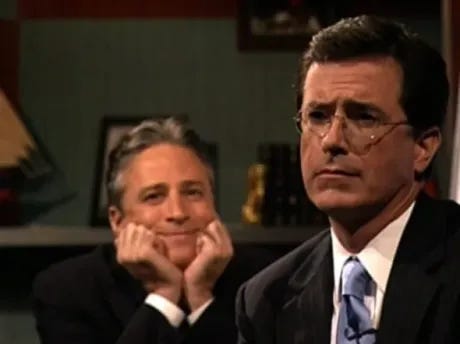
But the shift from cable to CBS sucked Colbert straight into the gatekeeping vortex, as he (and The Daily Show, Fallon, etc) interviewed any celebrity with a new book or movie to promote. But without the conservative mask, there was no irony and little criticism. Indeed, one of his very first guests in 2015 was Trumpus himself. Fans who expected irony were disappointed, as Trumpus refused to take the bait, and Colbert uncharacteristically apologized for past statements.
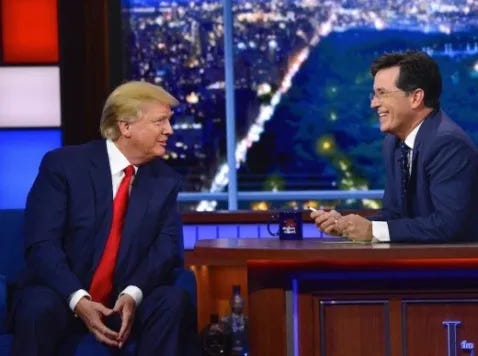
Indeed, his new interview format was typical network-style discussion: long on safe, predictable jokes, short on subversion. The effect was what we would later describe as “normalization,” something most media were doing. Nussbaum describes these interviews:
With the irony drained away, Colbert was less vivid. He had a try-hard earnestness, a damp corporate pall; he was courtly with guests, as if modeling bipartisan behavior. Taking off the mask had made him less visible, not more.
As Trump ascended, so did Colbert’s anger, but the format continued to dictate the content.
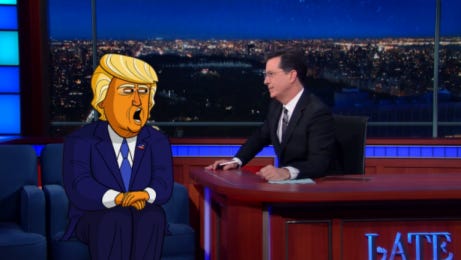
Attacking Trump is necessary and provides needed relief. But it isn’t threatening when everyone is doing it, and when it does nothing other than support the liberal narrative: If only the Russians hadn’t done that, we’d have a real president. Nussbaum continues:
Under an absurdist regime, intensified by the digital landscape…all jokes become “takes,” their punch lines interchangeable with CNN headlines, clickbait, Facebook memes, and Trump’s own drive-by tweets...Under these conditions, a late-night monologue begins to feel cognitively draining, not unlike political punditry.
To Stewart’s credit, he also seems to have got angrier. People whom the network refuses to allow on the Daily Show may appear on his Weekly Show podcast. Here, interviewing Amy Goodman of Democracy Now, he frankly acknowledges the difference between their shows:
I give information, and then Amy gives the correct information...The show that I do may be cathartic, but it’s impotent.
Goodman, however, doesn’t ask why he can’t have her on The Daily Show. Note also that Stewart must do commercials on these podcasts, including promotion of a news aggregator (gatekeeper) that describes CNN as “left-leaning”.
Much of what passes as political protest these days, like almost all comic attacks on Trumpus, are performative. We perform our allegiance to our tribe when we make fun of him without acknowledging how the Democratic Party has never distinguished itself from its corporate and Zionist patrons. It always comes back to gatekeeping, one of the primary functions, incidentally, of The New Yorker, where Nussbaum’s article appeared. Chris Hedges writes:
The fusion of politics, news, and entertainment has given prominence to (these) comics...attack dogs for the Democratic Party, which has joined forces with the establishment wing of the old Republican Party...By belittling Trump and his followers, these comics feed the smug, self-righteousness of the ruling establishment, bolstering their sense of moral and intellectual superiority...court jesters, never questioning the right of the rulers to rule or the terrible social injustices built into a rigged system...attack dogs for establishment power...(with) no effect on the political landscape...as loathed and ignored by Trump supporters as they are feted by Trump haters...They attack critics of the system even if these critics come from the left. John Oliver, for example, devoted a show to mocking Green Party presidential candidate, Jill Stein...a self-defeating cynicism that skews all critiques of the real configurations of power. Power only laughs at its own jokes...
Lenny Bruce, Richard Pryor, Dick Gregory, Robin Williams, Mort Sahl, George Carlin: comedy used to be about punching up. It still is, mostly. But they are all gone and, with the exception of Lee Camp, who has repeatedly been de-platformed, the punching is mild and safe. YouTube erased all 2,000 of his videos. In 2016 Camp had 330,000 followers and was gaining 5,000/week. After the election, FB “shadow banned” him, capping that number at 330,000 (by 2026, it had slowly grown to 364,000).
Now, haters have free rein to punch down, politics is nearly indistinguishable from comedy and angry Black men (with the exception of W. Kamau Bell) still don’t host TV shows. Keeping the assault on our innocence outside the pale is the main reason why gatekeepers do what they do, and why they are paid so well.
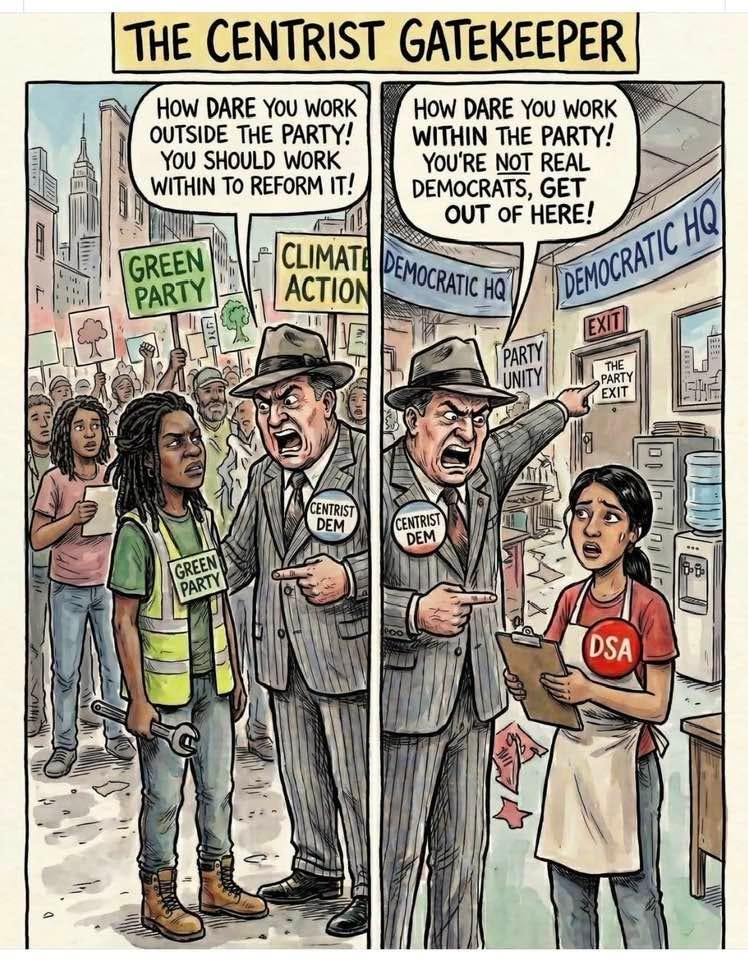
Everyone Colbert interviewed, no matter how heinous, became known afterward as “a friend of the show”.