In our time, political speech and writing are largely the defense of the indefensible.
– George Orwell
A newspaper is a private enterprise, owing nothing whatever to the public...It is therefore affected with no public interest. It is emphatically the property of the owner who is selling a manufactured product at his own risk. – Wall Street Journal, 1925
I published an earlier version of this essay in 2014. Now, as we find ourselves inundated with lies, “alternative facts”, biased “fact checkers” and algorithm-manipulated news reports calculated to confirm our biases – all of which make some of us want to fall back upon familiar, “reliable” voices of traditional media – it seems even more relevant.
It’s easy enough to roll our eyes and make fun of the MAGA crowd and their ignorant, racially coded statements, or to tell our friends, Did you see what Trumpus / Miller / Carlson / Hegseth / Vance, etc, said today? In-freaking credible! But it serves no purpose other than to entertain us. Stephen Colbert and others do this several evenings a week, preaching to their choirs, and they do it better.
It’s much more difficult, but potentially far more important, to identify the intentions of our media gatekeepers. Let’s think in terms of concentric circles.
Fox News, election-deniers, Breitbart, Alex Jones and even more extremist, white supremacist bloggers and podcasters are the outermost concentric circle of gatekeeping, where performative race-baiting and clownish entertainment masquerade as “opinion” or even as “news”.
The second, more inner circle is composed of CNN, MSNBC, the large daily newspaper chains and the major broadcast networks. There, manipulation of public opinion occurs in an older and subtler form. As Noam Chomsky has written,
The smart way to keep people passive and obedient is to strictly limit the spectrum of acceptable opinion but allow very lively debate within that spectrum – even encourage the more critical and dissident views. That gives people the sense that there’s free thinking going on, while all the time the presuppositions of the system are being reinforced by the limits put on the range of the debate.
This is not to say that mainstream media gatekeepers always deliberately lie, although many clearly do. The truth is that the vetting process, just as it does with politicians, produces a population of journalists who consume the same myths about America and its noble intentions that the rest of us do, and are paid handsomely to repeat them to us. When an exasperated interviewer asked if Chomsky thought the man was lying, he responded:
I don’t say that you’re self-censoring. I’m sure you believe everything you’re saying. But what I’m saying is, if you believed something different, you wouldn’t be sitting where you are sitting.
We read American and world history through their – often, quite biased – lenses. Bias can mean emphasizing a conservative view of events. Or it can mean marginalizing alternative interpretations, such as they have done in crafting our national understanding of World War Two, for example, or in their palpable disdain (and jealousy of) Howard Zinn.
I shudder to think that in 200 years (if this culture survives), history students will be reading the likes of Henry Kissinger and Bill O’Reilly, or for that matter, Bill Clinton, to learn about America.
Returning to the subject of the mainstream media, a practiced eye can discern three themes:
One: The “news” is merely an invitation to the real product, which is, of course, the advertising and commercials. Or, considered slightly differently, we are the products being sold to the advertisers.
Two: “If it bleeds, it leads.” Violence – both the threat and the fear of violence, as well as our fascination with both real and fictonal violence – make up the media sea that we swim in. The news reflects America’s unique love-hate relationship to it. As Archetypal psychologist James Hillman wrote, “harmless violence where no one gets hurt breeds innocence…the innocent American is the violent American.
Three: The bizarre mixture of these two themes produces a third one. Since they first attacked the American continent, white people have found themselves on the receiving end of constant, daily messages that they should be very, very worried. From Native Americans to Black men to Mexicans to Asians to Irish and other immigrants to Germans to Russian and Chinese communists to Muslim terrorists to Iranians, and now, back to Russians, Chinese and Venezuelan “drug cartels”, only the objects of our fears have changed.
And simultaneously, we learn that everything is all right in our fantasized consumer paradise, that buying stuff cures our worries. This kind of experience is called “schizogenetic”. In simple terms, this lifelong exposure to mixed messages makes us uniquely crazy, and this has been happening for a very, very long time. See my essays Shock and Awe and The Outside Agitator.
But the innermost – and most insidious – level is composed of the center of opinion, the Ivy-League-educated liberal bastions of reason: the New York Times, the Wall Street Journal, National Public Radio, the New York Review of Books, the New Yorker, The Wall Street Journal and the Washington Post. These are the sources that teach us the boundaries of acceptable discourse, outside of which are said to lie the demons of fake news.
We are grateful to the Washington Post, the New York Times, Time Magazine…whose directors have attended our meetings and respected their promises of discretion for almost 40 years. – David Rockefeller
These “legacy media” sources have instructed middle-class Americans in an almost religious faith in reliable, objective news reporting. As Maximillian Alvarez writes:
The biases of unreliable narrators (newscasters, candidates, uncles) may be glaringly obvious. But often they’re much harder to see, especially in narratives that claim to be objective. They’re often hidden in the details, in the language used, in specific word choices, in the things a narrator chooses to emphasize and the things she chooses to leave out, in tone, etc. To get at that stuff requires what literature scholars call “close reading.”…every narrative manipulates (or at least tries to). The ones that pretend they don’t are the ones people should be suspicious of.
Worth repeating: The ones that pretend they don’t are the ones people should be suspicious of.
In this world, the gatekeeping intent is the same in its corporate worldview to the others. The best of the gatekeepers, however, deliver it in a more elevated form, to a highly educated clientele, and it’s characterized by excellent prose, impeccable taste and soothing radio voices. Indeed, at this level, the messages are conveyed at least as much by style as by content. No shouting, name-calling, exclamation marks or all-capital-letters!
Well-meaning, university-educated, independent-thinking, liberal Americans are almost literally seduced by the arrival of the glossier versions, where subtle messages of support for the American empire are digested along with Armani ads (Heavens! I’ve used the passive voice twice in one sentence!) that subvert the bad news with a more fundamental message: consume or be left behind. In mythic terms: be glad you’re a hero and not a victim. As Jerry Falwell said, “This is America. If you’re not a winner it’s your own fault.” In this context, when we are free to turn the page, occasional images of poverty and suffering merely reinforce our sense of privilege.
We recall that all these purveyors of rational, thoughtful discourse have consistently supported every one of the United States’ dozens of military coups and invasions of Third World countries. Since at least 2015, they have been united in framing the “Russiagate” narrative, and almost all of their allegations (reported as news rather than opinion) have been erroneous at best and pure propaganda at worst.
The point is not that the Russian government may have attempted to influence American elections, but that such efforts pale in comparison to much more consistent and successful efforts by Israel, Saudi Arabia and, of course, the continuing and mostly unpunished Republican attempts to subvert the 2006 election, hack its voting machines, deny the final vote and prevent its certification. This was the real backdrop to the elections of 2016 and 2020.
Anyone who still reposts articles about “the Russians” or “the Chinese” needs to be reminded that the U.S. has been destroying elections and popular democratic movements in literally dozens of countries every year since the end of World War Two.
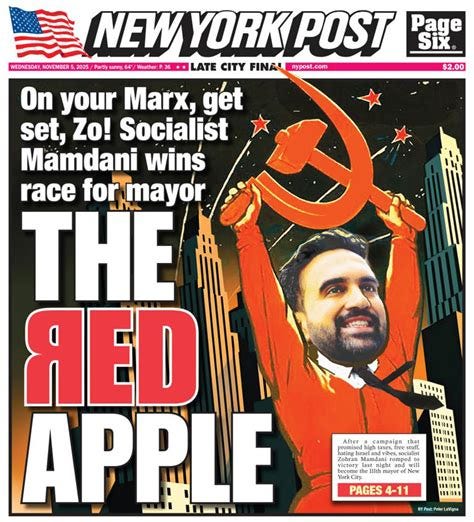
In 2021, the purveyors of high, dignified, liberal thinking published countless articles about why the U.S. should not withdraw its forces from Afghanistan. More recently and most egregiously, they have consistently been willing to ignore or at best minimize the Israeli genocide of Palestine. But their articles are so much better-written than those of the New York Post, even if they support the same reactionaries.
Meanwhile, despite their reasoned arguments, trust in mainstream media has plummeted to an all-time low. Although this has opened up a vast can of rightwing, QAnon and MAGA internet worms, in the long run it may be a good thing. Only when old, unsatisfying mythologies collapse and their priests are sent packing can we learn media literacy and begin to imagine purveyors of the news that can be trusted.
It is difficult to get the news from poems, yet men die miserably every day for lack of what is found there. – William Carlos Williams
Part Two
Education is indoctrination if you’re white – subjugation if you’re black…The paradox of education is precisely this - that as one begins to become conscious one begins to examine the society in which he is being educated. – James Baldwin
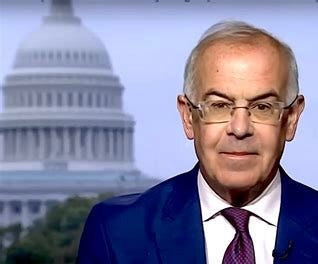
So let’s talk about an influential journalist and how to read him with the eye of a mythologist. David Brooks is a gatekeeper of the first magnitude. He has been called the sort of conservative pundit that liberals like, one who “engages” with them and praises the “moderate majority” of Americans. He has shown contempt for Tea Partiers and Trumpus while occasionally supporting Barack Obama. Now that’s reasonable.
While Brooks does offer some insightful comments, it’s critical to understand that he, like all insider gatekeepers, is writing from within the bubble of American Innocence and privilege. In doing so, he is implying that all “reasonable” readers share his basic assumptions. He is inviting you and all who consume the NYT to join him in a comfortable space where none of those assumptions will be endangered.
But some of us who watch from outside of the bubble have realized that we must do more than pontificate about politics and culture, even about myth itself. We must learn to think mythologically in order to extricate (liberate, if you prefer) ourselves from the flawed mythologies that no longer serve us, and the ways in which they are intended to reinforce our fragile sense of who we are. No wonder that making fun of “woke” people is at the top of Tucker Carlson’s agenda.
Once we see how much the narrative of politics is controlled by storytellers – journalists, commentators, speech writers, textbook writers, candidates, televangelists, national monuments – we grow suspicious. We remember, as Hillman wrote, “…that peculiar process upon which our civilization rests: dissociation.” Only such a dissociated stance – precisely the one that Brooks offers us – can enable us as individuals and as a nation to go on drooling over those Armani ads while our military (abroad) and our militarized police (domestically) continue to wreck biblical violence upon the Others of this world.
Thinking mythologically helps us to identify the voices of the gatekeepers. Such voices (formerly the priesthood, now the New York-based media) set the limits of acceptable debate and subtly reinforce what Joseph Campbell called the sociological level of myth, which is composed of the narratives that validate the existing social order. Brooks does this in his first two paragraphs by implying that “the dream of the beautiful collective” (he means “socialism”) is antithetical to “universal democracy,” and later by stating categorically that “capitalism is necessary.”
I am not arguing that socialism is a panacea. Our problems go way beyond such (quite necessary) considerations of how wealth should be created and distributed equitably. I’m simply pointing out that our responsibility as mythologists is to deconstruct such skillful writers as Brooks and identify their agendas.
When he writes, “Americans felt responsible for creating a global order that would nurture the spread of democracy,” we need to understand that he is referencing one of the most fundamental assumptions of the myth of American Innocence, that America has a divinely inspired, Christ-like mission to save the world, one that unfortunately requires hundreds of military bases and the constant threat of interventions, coups, assassinations and regime changes. Accepting that statement, ten generations of American parents have offered their sons (and now their daughters) as sacrificial offerings to Ares, the god of war. And they have willingly ignored the suffering that the empire has inflicted. As an American officer in Viet Nam lamented (or bragged), We had to destroy the village in order to save it.
It was no accident that Brooks wrote this article just as the debate about attacking Iraq yet again was heating up in the media. The “loss of faith” he worried about is the decreasing willingness to blindly support our leaders in yet another military intervention in the Middle East.
For more on Brooks’ agenda, see “Sing in Unison, David Brooks Tells Black Athletes”, in which he advises football players not to kneel when the National Anthem is played because their activism might be counterproductive. With this patronizing nonsense, he reprises a sixty-year-old liberal nostrum: “We support your aims but not your tactics.” Ari Paul breaks down some of Brook’s pretensions to understand the MAGA crowd:
Brooks and the Times are playing the tired role of using petty cultural politics to ignore economic reality and portray the Republicans as the voice of working America (FAIR.org, 10/9/15, 3/30/18, 11/13/18).
If the Nuremberg laws were applied, then every post-war American president would have been hanged. – Noam Chomsky
That’s a provocative quote, and it has serious implications. Is Chomsky being literal? If we take it at face value – culpability in the bombing of over forty sovereign nations since the end of World War Two, murder and torture of literally millions of civilians and indigenous people, CIA drug running and assassinations, environmental destruction and global warming – then anyone in government, military or corporate capitalism who knowingly took part in such activities shares the responsibility. And the storytellers, anyone of influence in education, media, religion, the history profession and especially “journalism” – who abetted such activities by subtly justifying them is also responsible.
Knowing that fear of the Other is one of my major themes, another friend recommends a Brooks article: “On Conquering Fear”. It references the Passover prayer book (the Haggadah) and offers “subtler strategies and techniques to conquer fear.”
Brooks tells us that in the Moses story, Hebrew married couples were immobilized by fear of Egypt’s Pharaoh. But by “challeng(ing) each other to see beauty in the other,” they “began to sense unexpected possibilities.” Once people started speaking to each other and telling stories to each other, they generated alternate worlds. Storytelling became central to conquering fear. A story isn’t an argument or a collection of data, he says. It contains multiple meanings that can be discussed, questioned and reinterpreted (and that’s exactly how we need to respond to Brooks).
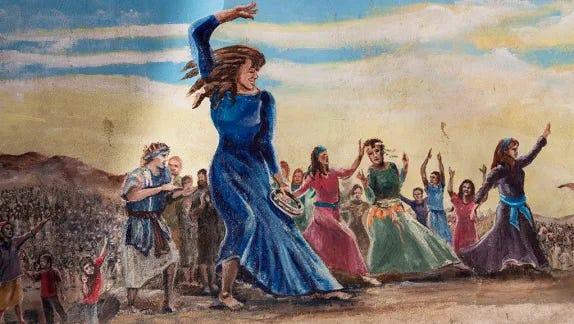
Later, at the critical point when the Israelites face the crossing of the Dead Sea, they begin to sing – not in celebration, but to overcome their fear.
Their “climactic break from bondage is thus done in a mood of enchantment.” So “the sophisticated psychology of Exodus” teaches that it is sometimes wise to confront fear “obliquely and happily, through sexiness, storytelling and song.”
I sincerely praise Brooks for a fine article. In this age of heightened – and manipulated – fear, we could all appreciate this message. Perhaps the only way to transcend the paranoid imagination is by turning toward the creative imagination through art and ritual.
But we can’t consider what this article says without acknowledging what it doesn’t say. This is my responsibility as a mythologist to you as the reader. Then it becomes your responsibility to think mythologically, to train yourself to identify the subtle ways in which media gatekeepers continuously manipulate our narratives to revive the myth of innocence. So let’s unpack it.
First of all, consider the massive irony that an article about facing fear was penned by a persuasive media giant who has supported every one of the American empire’s military adventures with all the usual fearmongering and has written countless other articles that have helped to ratchet up the level of fear in the culture. The media watchers FAIR (Fairness and Accuracy in Reporting) include Brooks in their list of “Highly Placed Media Racists.” Why? Because his “reasoned, moderate” essays often reference outright, unreconstructed bigots.
If his article has any wisdom to offer, remember the old joke that even a broken clock is right twice a day. Now let’s look at the text of the article, which constantly refers to the myth (remember that there is very little if any archeological record for it) of the Exodus. Consider two points:
One: the people in his story who experience fear are the Israelites, not the Egyptians. Stories of Jewish fear are familiar to us, and they are quite justified from Roman to medieval persecutions to the Holocaust, all the way to the current moment when antisemitic crimes are peaking once again and unrepentant anti-Semites are very influential in the Trumpus administration.
However, the article, published during the debate about Iranian nuclear weapons (a debate that never mentioned Iranian fear of Israel’s nukes) subtly reinforces the theme of Israeli fear of Muslims, especially Palestinians. Yes, I know that Egypt and Saudi Arabia indirectly support the genocide of the Palestinians, and Iranians are not Arabs. But we are talking about images, not objective truth. We’re talking about stories that, like almost all foreign policy issues, are constructed for domestic consumption – not for Iranian diplomats, but for fundamentalist voters in red states and Jewish campaign donors in blue states.
I’m not nitpicking here. This toxic narrative is a long-term constant in our media, and it completely inverts reality. What is reality? The actual, overwhelming fear of Israeli violence that all Palestinians experience, every single day of their lives. Reality is that at least as far back as 2018, Gaza was being referred to as the world’s largest open-air prison, where (in 2012, long before the outright starvation in 2025) Israel had calculated the precise number of calories allowed per person to avoid starvation. It’s an ongoing, bone-crushing, cumulative, epigenetic trauma that in our society can only be compared, weakly, to the anxiety felt by all Black men driving cars who encounter the police.
Let’s be clear about this. Inverting reality is one of Brooks’ primary functions as a gatekeeper. Can you imagine him, or any NYT writer, telling a story with the same “anti-fear” theme, but with Palestinians as the subjects?
And, before I’m accused of being a self-hating Jew, let me remind you that this is not really about Israel. It’s about Israel’s function as a surrogate for an American foreign policy that has remained remarkably consistent for sixty years, regardless of who has been President. And it’s about mythic narratives, including the remarkable similarity between the myth of American innocence and the myth of Israeli Innocence.
My second point repeats one of the primary themes of my book. The grand tale of American exceptionalism – that America is the one nation divinely ordained to bring freedom and opportunity to the rest of the world – was originally born in Biblical terms. The seventeenth century myth likened the Pilgrims to the Israelites. The English Church and Crown represented Pharaoh and the Native Americans became the Philistines (which, by the way, is the Arabic word that modern Palestinians use to describe themselves: Philistina). Fear of those Native Americans, whether real or constructed, became the most basic, essential factor in the American story.
In this manner America offered its original sin and contradiction to the imagination of the world. Our tales of liberation were bound up from the start with the original, Hebrew invasion of Palestine.
The quest for liberation from fear justified that Biblical conquest and served as the template for Euro-American colonial aggression. In the “either-or” context of monotheistic narratives, it is a simple series of steps from difference to fear to slavery to escape to journey (a journey that has no initiatory significance) to arrival (rather than homecoming). But the steps continue: to invasion to conquest to colonialism to exclusion to ghettoization and eventually and inevitably to genocide.
In the process, some victims of history become perpetrators of the same crimes that had been done earlier to them, passing on the trauma to other people, and the guilt to their own children. God commands and the invaders obey. Or do invaders create new myths to justify their crimes? Just what do you suppose happened to the indigenous population of Jericho once “the walls came a-tumbling down?” The Israelites, so recently liberated from slavery themselves, gleefully recorded the results:
And we captured all his cities at that time and devoted to destruction every city, men, women, and children. We left no survivors. (Deuteronomy 2:34)
I re-posted this essay about a week after hundreds of extremist Israeli Jews, egged on by Benjamin Netanyahu, marched through Jerusalem shouting “Death to Arabs!”, attacking and wounding over 100 Palestinians. Speaking of gatekeepers, note how CBS characteristically chose to report the event: “Officers injured, 40 arrested in Jerusalem as hardline Jewish group and Palestinians clash with police during Ramadan.”
The religious rationalization of genocide, the narrative of the Israelite conquest of the Holy Land, written at least a thousand years before the advent of Islam, became the ideology behind the crusades, European colonialism, the invasion of the Americas and all the subsequent wars of American history. Ironically, the modern conquest of Palestine took much of its energy from American “manifest destiny,” which, as I have shown, was itself modeled upon the Israelite conquest of the Philistinas.
But Brooks tells us that the Israelites feared Pharaoh. Again, we focus on what he doesn’t say: how sometimes we come to identify with our own oppressors, how the victims of Nazi barbarism became barbarians themselves. In Auschwitz and other death camps, the SS recruited many Jewish collaborators to brutally control behavior among the prisoners – until they themselves were sent to the crematoria. They were called “kapos,” a term that David Friedman, Trumpus’ ambassador to Israel, used to insult American Jews who criticize the U.S.’s support of Israeli apartheid.
Am I nitpicking to remind you that Brooks neglects to mention that centuries after the Children of Israel escaped destruction by Pharaoh (and slaughtered the population of Jericho), their descendants would kill 504 Gazan Children through aerial bombardment in the summer of 2014? Or that, when they ran low on ammunition, Barack Obama quickly re-supplied them? Or that eight months later, not one of the 9,000 houses completely destroyed in that attack had been reconstructed? Or that this happened nine years before Genocide Joe Biden upped the ante of military support even further? Or that Kamala Harris lost the ensuing presidential election because she wouldn’t denounce that policy?
I know, I know. Why focus on the negative? Of course, there’s no need to bring this dark stuff up in the context of a truly uplifting story. But do we have the privilege not to do so? The mandate of Depth psychology is clear: we must become conscious of the fullness of reality, both the awe and the terror. It tells us that the victims of history cannot “conquer fear” simply by singing, and certainly not by projecting its source onto other victims.
Either we all face our fear or none of us can.
Brooks continues: “Eventually, the Israelites are able to cope with fear. This makes them capable of loving and being loved.” I say: May it be so. May we all take his advice. May Brooks take his own advice.
He concludes his article: by “challeng(ing) each other to see beauty in the other,” they “began to sense unexpected possibilities.” I say: We cannot truly see the beauty in each other unless we can see it in all the Others of the world. I say: May we all realize that our fear of the Other mirrors our fear of recognizing our deepest selves. I say: May our collective, creative imagination make art out of our fear and our grief.
Hafiz says:
Fear is the cheapest room in the house. I’d like to see you in better living conditions.