
Part One
Spiritual and mystical literature often speaks of the need to pay full attention, to be present moment to moment. What some call “soul-work” asks us to focus our awareness of both the outer and the inner worlds with a detached, witnessing perspective, even while, as Joseph Campbell wrote, “participating joyfully in the sorrows of the world.”
A large part – or many parts – of the self are normally hidden from conscious awareness. Indeed, cognitive linguist George Lakoff claims that only five percent of our thinking is conscious. So, paying attention (from the Latin, “to stretch”) forces us into the awareness of infinite complexity and mystery. Resisting the temptation to resolve the big questions of life into simple, black-white dualities – the legacy of monotheistic thinking – we attempt to hold the tension of the opposites. Otherwise, we risk a disruptive return of the repressed.
Most people throughout history have not aspired to become yogis meditating in caves. Far more have chosen the way of the indigenous, creative imagination: turning life’s tragic contradictions and impossible choices into the images of art.
But what about social groups? Is it necessary or even possible for an entire society to hold that kind of attention, if only for a brief but intense time, to acknowledge the presence of its own shadow? Communities cannot enter psychotherapeutic relationships; they can only approach the unconscious through communal ritual within a broad mythic container.
In highly structured, urban societies – such as classical Athens – that emphasize logic and rational thinking, the shadow is the unreasonable, violent and uncontrollable force of natural life. Like the ivy plant in a garden, it continually threatens to creep stealthily across the carefully contrived boundaries of the social role or mask – the persona – that we show to the world.
For the Athenians the mythic image that expressed the irrational, the paradoxical and the mysterious was Dionysus, the god of wine and of the extremes of both ecstasy and madness. In his inebriated yet exalted state, he could bring both joyous celebration and chaotic violence. He was paradox: the only god to suffer and die, and yet to always return. For a few centuries Greek myth and ritual struggled to hold the tension, the mystery and the tragedy of life that he represented. Classicist E. R. Dodds acknowledged that the rationalist Athenians “were deeply and imaginatively aware of the power, the wonder, and the peril of the Irrational.”
They knew the price that the psyche – and the community – paid for ignoring the mad god and his passions. Many of his myths told of the destructive vengeance he visited upon those mortals who denied the truth. In story after story, Dionysus arrived from afar with his retinue of dancing, female maenads (related to mania)
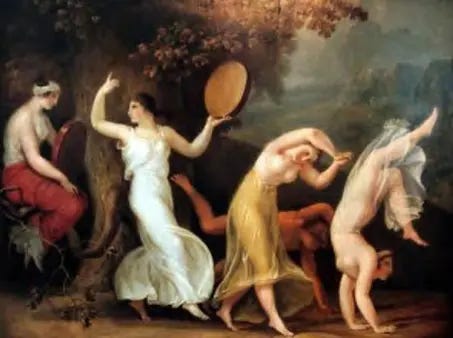
and drunken male satyrs, only to be rejected by such mythic figures as Lykourgos, Minyas, Proetus, Eleuther, Perseus, and most famously by Pentheus (in The Bacchae by Euripides.)
Time after time, Dionysus punished the unbelievers or their kin with madness. We are not talking about neurosis or depression. We are talking about madness so extreme, so severe that it caused them, knowingly or not, to slaughter their own children.
The three daughters of King Proetus of Tiryns refused to join Dionysus in his wild revels; in response he struck them mad. They infected other women with their insanity, and all left their families. Some wandered as nymphomaniacs; others killed and ate their own children. Similarly, the women of Thebes who had rejected the God (including his own mother) went violently mad.
The Athenians told an old story: once in the dim past, when the statue of Dionysus was first brought to the city, they did not receive it with appropriate respect. Angered, the god sent an affliction on the genitals of the men. They were cured only when they duly honored him by fashioning great phalluses for use in his worship. After that education in proper respect, the Athenian empire required its colonies to send phalluses (along with tribute) as part of his annual celebrations.
Scholars call these legends “myths of arrival” that explain the spread of new cults. But we are looking for the archetypal implications. Why did the gentle and effeminate god of ecstasy arrive with such ferocity? Like alcohol itself, he loosened inhibitions. He was known as Lusios, the “Loosener.” James Hillman pointed out that the word is connected to lysis, root of the word analysis, which means “loosening, setting free, deliverance, dissolution, collapse, breaking bonds and laws, and the final unraveling as of a plot in tragedy.” A catalyst is an agent, chemical or otherwise, that precipitates a process or event, without being changed by the consequences.
What lies below the surface has great power because, like a diamond, it has been compressed by time. Like all the “Others” of the world, the god has experienced the shame of having been cast out, ignored, beyond the pale, among the barbarians, into the underworld, to lick his wounds and nurse his resentment. Are we really surprised that when he is invoked unconsciously, passively, or symbolically (by consuming spirits) he is as likely to bring rage as he is to bring ecstasy? When he comes back – and he always does, like ivy – the psyche experiences his arrival as the violent return of the repressed. But it need not always be this way. Psychologist Nor Hall comments on those daughters of Proteus:
Their bodies become covered with white splotches, and they are set out upon the hills to wander like cows in heat. Only now are they fitting partners for the God in bull form. Had they joined the Dionysian company willingly they would have enacted this state of wild abandon within a protective circle.
Indigenous ritual seeks to retrieve a state of balance that has been lost. To do so, it may involve – within such a protective circle – the symbolic enactment and emotional experience of our deepest conflicts and irreconcilable opposites, with the intention that such discord might not have to erupt – and disrupt – literally. Intention requires paying attention, to both the outer and the inner worlds.
The Athenian religious and political leaders were faced with the question of how to pay attention to Dionysus – something they would rather not have done. How could they consciously invite this mad, unreasonable god of vengeance and wild emotional extremes – the “Other” – into the center of the city in the hope that he wouldn’t take vengeance? One way they accomplished this was in the Dionysia, the annual productions of tragic drama in March, where the entire city endured the tension of holding irreconcilable opposites together, as enacted onstage. These productions were traditionally held in the Theater of Dionysus, where the mad god was known as the patron of their highest art.
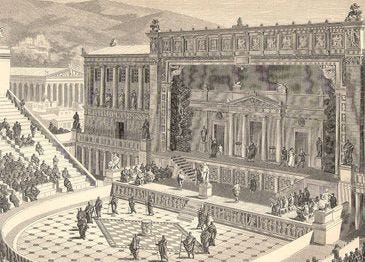
Also in late winter (the previous month, in early- to mid-February), they celebrated a festival called the Anthesteria – the festival of flowers – during which the new wine was opened. The city invoked Dionysus “as a purifier, not as a destroyer,” writes Charles Segal. The God arrived “bringing the life-enhancing benefits of viticulture and the drinking of wine.”
The Anthesteria was one of the earliest European all-souls’ festivals, in which the citizens welcomed the spirits of the dead, and along with them, Dionysus, back into the city for three days of drinking and carousing. But, strange as it may seem to modern consciousness, historians tell us that the joy alternated with deep somberness, even grief. Apparently, Athens retained a memory of the ancient knowledge that it was impossible to invoke one extreme of experience without paying attention to the opposite extreme – no ecstasy without grief, and vice versa.
In the ritual, Dionysus, played by one of his priests, ceremonially returned from his annual sojourn in the underworld (or, if you prefer to think psychologically, he arose into conscious awareness). Wearing a two-faced mask, entered the city on a wheeled ship that was crowned with vine tendrils and pulled by panthers.
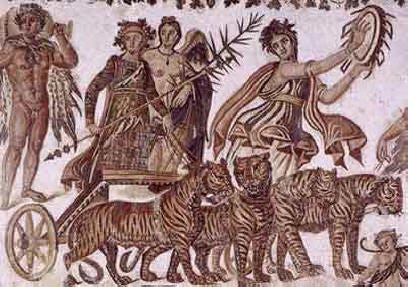
The citizens welcomed the god together with his wife Ariadne, the two of them returned from the sea, that universal symbol of the collective unconscious. We recall how Ariadne had helped save Theseus from the Minotaur, the dreadful monster of the labyrinth; how Theseus had abandoned her on an island; and how Dionysus had saved her. To celebrate their sacred marriage – the hieros gamos – Dionysus gave her a jeweled crown, which he later placed in the heavens as the constellation Corona Borealis. Dionysus also inspired the tradition of wearing masks in these processions. As classicist Walter Otto wrote:
Because it is his nature to appear suddenly and with overwhelming might before mankind, the mask serves as his symbol and his incarnation in cult…linked with the eternal enigmas of duality and paradox.
The Greek word for mask was persona. The mask symbolized the untamed forces of nature that lay just below the surface of appearances. Our words person and personality derive from that same source.
Similar festivals were held in mid-winter in Egypt and Rome. In Later centuries, Christian Europe celebrated Carnival at this time, and to this day masked revelers often tow the carnival King and Queen through the streets, just like Dionysus and Ariadne, on a wheeled ship. One of joys of Carnival has always been to briefly embody the identity of another person – or to pay attention to another part of own’s own psyche.
Carnival was a time out of time, emphasizing both the liminal betwixt-and-between state as well as the cyclic nature of existence. It was a period of humor, paradox, wild behavior and a temporary inversion of the social order, with a breaking of taboos that bordered on subversion. Anthropologist John Jervis writes that the people celebrated the body “…in all its messy materiality: eating, drinking, copulating, defecating, procreating, dying…” To an extent almost unimaginable today (except, perhaps, in New Orleans), entire communities participated – briefly – as equals, with little distinction between performers and audience, many of whom wore death masks. Amid the merriment, one can still observe the ancient theme of welcoming the spirits of the dead back to the world of the living for a few days. Indeed, in many places the celebration of Day of the Dead is nearly indistinguishable from Carnival.
For Christians, the joy precedes the austerities of Lent. And they invoke a different god of suffering and love – a spiritual god who is disconnected from his dark, physical twin. That twin remains in the underworld plotting his revenge. But in the Protestant, Jewish and Moslem worlds, he is disconnected – unlike Dionysus – from his mother as well.
Part Two
Many indigenous societies believed that the dead were always close by at the times of the greatest celebrations. The mid-winter festivals that came to North America as Mardi Gras (with its Jazz funerals),
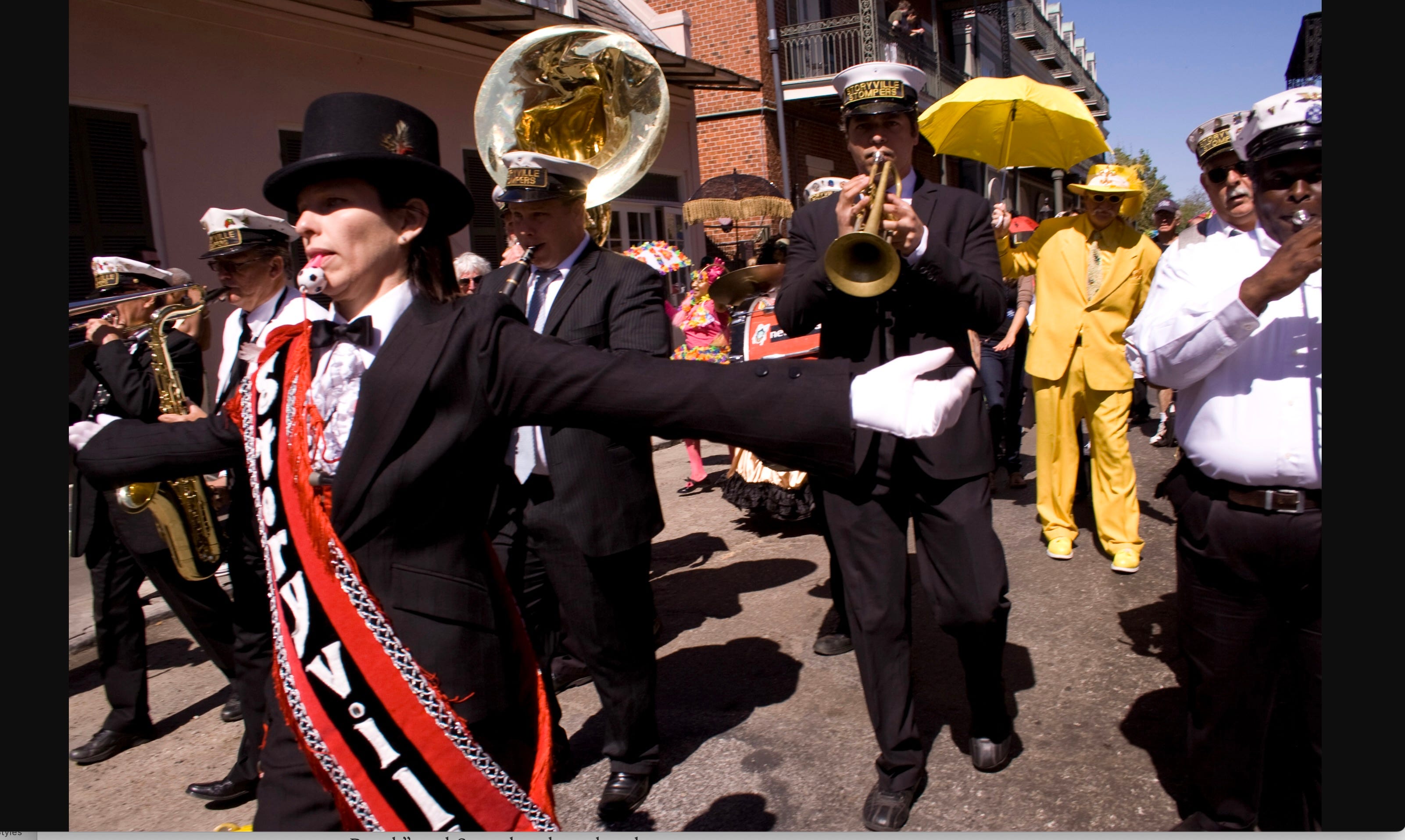
as well as the early November celebrations in the Celtic world, looked forward to the annual restoration of the world that would come in springtime. But the elders taught that renewal would be unlikely unless due attention were paid to that which must die, as well as to those who had already died and become ancestors, and those – like Dionysus – who had died and been reborn.
Certainly, in authoritarian systems the political and religious elites have understood the importance of allowing the common people to let off a little steam for a few days once a year. Jervis notes that “the symbolic inversion revealed the absurdity of a real one.”
Modern culture has long since literalized carnival to its “toxic mimic,” a vacation in chaos: the secular, consumer-oriented spectacles of Halloween, Las Vegas, “Spring Break” and Superbowl weekend.
But even today, the Greek town of Monoklissia celebrates a festival called the Gynaekokracia (“rule of the women”) in which the genders invert their traditional roles for one day. Like all carnivals, it serves the two-fold purposes of releasing the tension produced by traditional repressive cultures and also re-affirming their rules, revital-izing the social order by reenacting its conception. Patricia Storace describes the scene: “The transvestism here is a social, even a political transvestism – the men are not just dressing like women but being treated like women by women mocking men’s behavior.”
But the original carnival, the Anthesteria, was – or at it least recalled – something very significant from the ancient past. Most important, for our purposes, the basilinna, the wife of the religious king of the city, or archon bassileus (related to basilica) engaged in a highly publicized, ritual copulation with Dionysus. The conventional scholarly explanation of this holiday is that, in addition to maintaining the social order, it celebrated and recapitulated the original marriage of Dionysus and Ariadne and was a fertility ritual intended to ensure good crops.
This may be accurate on a sociological level, but it is also undoubtedly true that many of the citizens were paying attention to a conscious re-enactment of the hieros gamos, a mythic union that had its roots in the pre-patriarchal Minoan era. Why is this ritual marriage so meaningful? Karl Kerenyi wrote that just as Dionysus was the embodiment of zoe, “the archetypal image of indestructible life,” so Ariadne was “the archetypal reality of the bestowal of soul, of what makes a living creature an individual.” The union of this divine pair thus represented the “eternal passage of zoe into and through the genesis of living creatures.”
It was the sacred marriage of goddess and consort, or the inner king and queen who met each other in the sea of the unconscious. It was a reminder of the ultimate unity of opposites that lies behind the mask and the apparent dualities of the world.
Twenty-five centuries ago, this indigenous knowledge was still barely alive in classical Athens: the proximity of fertility and decomposition, of the goddess Persephone and her husband Hades (known as Ploutos, or “wealth”) – and of Dionysus in his many roles of divine child, mature initiator and threat to the social order. The polytheistic imagination could still hold such paradox, even as the age of science and rational philosophy approached and the celebration of mystery was degenerating into mass religion.
We cannot know what occurred when the queen met Dionysus, or what meaning the citizens saw in it. Whether she lay with the king himself or a priest of Dionysus, or if either man was masked as the god, or whether their union was consummated literally, doesn’t concern us. The important thing, according to classicist Richard Seaford, is that there was an “…invasion of the royal household by a publicly escorted stranger who symbolically destroys its potential autonomy by having sex with the king archons’s wife.”
Dionysus Lusios – the “Loosener”– suddenly appeared at the head of a great procession, announcing his presence at the palace of the archon to claim the Queen for his own! And that night, all over Athens, men donned masks and impersonated the god at the doors of other men or women. For one night, everyone happily ignored the conventions of gender and social class. But soon after, in daylight, they swept through the streets chasing the keres, the spirits of the dead, out of the city for another year.
Perhaps – just perhaps – we have here a partial record of an advanced urban civilization that recognized the absolute necessity of welcoming in the shadowy, wet, irrational, uncivilized stranger (xenos, the root of xenophobia, can mean both “stranger” and “guest”) along with the spirits of all those who had died unreconciled and ungrieved.
Perhaps the leaders hoped that these rituals might minimize the possibility of any violent eruption of repressed energies that might topple the twin towers of religion and state. Perhaps they had reason to believe that, because of the ritual attention they paid to the Lord of the Darkness, there might not be an unintended, destructive, literal return of the repressed, in the city or in their souls.
But by the time that The Bacchae’s was first performed (405 BC), Athens had been in a constant state of war with Sparta for over 25 years. Public life had become characterized by militaristic vigilance and even more rigid class and gender roles. Clearly, people felt deep tension and anxiety that institutions such as the Anthesteria and other occasional opportunities for release could only partially resolve.
Dionysus stood squarely at the center of this paradox, serving both the needs for release of the under-classes as well as pointing the way toward participation in the greater mysteries of the soul. And so, writes Arthur Evans, he represented the return of the repressed in several senses:
…return of the religious needs of the lower classes, return of the demands of the non-rational part of the self, and return of the (ancient) Minoan feeling for the living unity of nature. And so, in return he threatened several repressors: the aristocracy of well-to-do male citizens, the domination of intellect over emotion, the alienated ethos of the city-state.
Perhaps the subtle balance between citizen, psyche and city – the world’s first large-scale experiment with democracy – could not have been expected to survive for long in such a world of slavery, misogyny and militarism. Eventually, the repressed would return in the form of barbarians from without as well as demons from within.
Like Athens, the American empire has been at war almost continually since World War Two. Like the Thebes of The Bacchae, our leaders are unrepentant misogynists, and our class, gender and racial hierarchies are nearly as rigid as they were in 1860. Millions self-medicate with opioids, and fascists march in the streets in a twisted parody of the ancient processions.
But the communal ritual of invoking and welcoming the spirits of madness, ancestry and the irrational remains an alternative, imaginative model for an American culture that is based so deeply on the denial of both death (and so must repeatedly inflict it upon others); a culture that is, in poet W.S. Merwin’s words,
…up to its chin in shame living in the stench it has chosen...
Reviving such festivals in all their paradox of chaotic ecstasy and grief – holding the tension of the opposites – is a necessary step in drawing back our obsessive national projection of “the Other” from gays, women, immigrants and people of color. Paying attention to Dionysus could be a step in awakening white America from its four centuries-long fantasy of innocence.