
PART ONE
What went before, as told by those who think they know it. – Gary Snyder
Historian: an unsuccessful novelist. – H.L. Mencken
History will be kind to me, for I intend to write it. – Winston Churchill
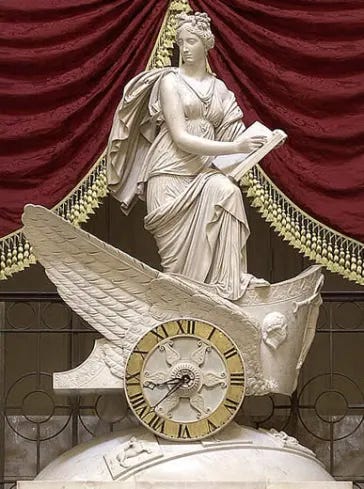
I invoke the muse of history, Clio, daughter of Zeus and Mnemosyne (Memory).
Book banning in America began in 1637. There were almost 12,000 book bans during the 2025-2026 school year, the highest number ever. There have been 34,000 book bans since 2021, when Fox News stoked the Culture Wars by disparaging critical race theory 1,300 times in four months. Politicians went full-paranoid on white replacement theory, after which Congress passes the “Crucial Communism Teaching Act”. In Texas, which has seen over 8,000 book bans, a tenured professor was fired for speaking at an online socialist conference.
Trumpus established the bogus 1776 Commission to promote “patriotic education”, suggesting that Martin Luther King Jr, whom Republicans love to misquote, would have opposed affirmative action. One of the groups lobbying for book banning is Moms For Liberty!
Twenty states have passed laws or issued statewide rules that aim to restrict the ways educators can teach uncomfortable subjects like racism or sexism. A right-wing “scholar” suggests, “Ban critical race theory now. States must enforce the principles of the Civil Rights Act!” At least four states have done that, and another dozen are debating the issue, which is – do I really need to say this? – sheer idiocy at best, and cynical, unrepentant racism and misogyny at worst. In addition, dozens of states have considered anti-LGBTQ bills.
In 2026 the Supreme Court admitted its plans to ban abortion rights by citing a 17th-century witch hunter. You can’t make this shit up.
Everywhere, reactionaries are scurrying to shore up the latest cracks in the façade of the myth of American innocence by controlling the narrative of our history.
It’s all being done, of course, by Republicans, usually in safely Republican states, meant primarily as performative entertainment for the choir, since most history education in those states has already been controlled for generations by racists and religious inquisitors. I’ve addressed this theme in detail here. Powerful Southerners want to retain their influence by any means, including the perpetuation of ignorance.
They want to decide how their – and increasingly your – children think and what they know about two main issues characteristic of 1950s white thinking. The first: discrimination based on race, gender and sexual orientation as reflections of acceptable traditional values.
The second – propelled as much by Democrats as Republicans – involves reviving the old, bipolar Cold War narrative. One side is allegedly a “free world”, whose intentions are universally benign, that never provokes international conflict. The other, so we are told, is hostile, dictatorial and expansionist.
But this essay is pursuing bigger game. For most of human history, the shamans and poets – and later the priesthood – served as the gatekeepers of culture and memory, channeling everyone into the narrow confines of acceptable opinion regarding everything from personal behavior, to national identity, to which “Other” people to hate. William Stafford realized this at a very young age:
Learning
A piccolo played, then a drum.
Feet began to come – a part of the music.
Here comes a horse, clippety clop, away.
My mother said, “Don’t run –
the army is after someone other than us.
If you stay you’ll learn our enemy.”
Then he came, the speaker.
He stood in the square. He told us who to hate.
I watched my mother’s face, its quiet.
“That’s him,” she said.
The result is what used to be our generally agreed-upon collective memories, which psychologist Jeremy Yamashiro describes as
…those representations of the shared past that members of a community hold in common. Collective memory is different from history. Whereas historians aim to create a relatively objective account of the past using rigorous professional standards...when members of a community recall their collective past, they do so through the filter of a contemporary set of concerns…These selective renderings help us create imagined communities – nations, races, religions, “the West” – by endowing those communities with a story of continuity and self-sameness across time.
Do historians create objective accounts of the past? Is their work really any different from collective memory? Peter Novick acknowledges that,
Everything comes to the reader as interpreted by the historian. Everything is seen through the medium of his personality. The facts of history when they are used to teach a moral lesson do not reach us in their entirety…but selected and arranged according to the overmastering ideal in the mind of the historian. The reader is at the historian’s mercy.
“There is no such thing as collective memory,” wrote Susan Sontag. “…what is called collective memory is not a remembering but a stipulating: that this is important, and this is the story about how it happened.”
Another way of talking about collective memory is to use the language of mythology. Joseph Campbell taught that a living myth refers past itself to the ineffable, serving four distinct functions. The mystical function introduces the individual to that which underlies all names and forms. It awakens religious awe, humility and respect. Second, the cosmological function explains how the universe works. Third, the pedagogical function defines a moral life as defined by each culture.
Fourth – and most pervasive – the social function validates the social order and integrates individuals within it. Originally, this oriented people to the mystery by presenting noble figures at the center of the realm who channeled and radiated the blessings that flowed through them from the other world, and implying that everyone carried such potential. The word “noble” is related to “knowledge.” A noble is one who knows themself. If people still revere royalty in places like England and Thailand, they may be accessing some vestigial memory of what sacred Kings once meant, beneath the smarmy veneer of celebrity culture.
We know who we are because gatekeepers teach us. However, in modern culture, “it is this sociological function of myth that has taken over,” wrote Campbell, “...and it is out of date.”
When I speak of myth in this article, I am referring to it as it has devolved in a world that, as Campbell wrote, is demythologized. That is to say, the first three functions are essentially gone, and we are left with only the fourth, sociological function. In a demythologized world this function is essentially identical with the narratives put forth by ruling elites. They do not feed the soul, and when we are honest with ourselves, we admit it.
Myth shapes our values, organizes our experience, brings emotion to our festivals and sacrifices, sets the boundaries of dissent, names the children, sends them off to war and justifies their deaths. It is the most compelling story we tell ourselves about who we are, especially when we hear it from those upon whom we project our own nobility. We need stories to tell us who we are. And frequently they are the stories of who we are not – the Other – and why we are periodically compelled to sacrifice the best of our young people in war. For a deeper understanding, read Blood Sacrifice and the Nation by Carolyn Marvin.
This effort requires the coordinated efforts of all our gatekeepers. To counter them, Howard Zinn – the guiding spirit of this essay – wrote:
The more widespread is education in a society, the more mystification is required to conceal what is wrong: church, school, and the written word work together for that concealment...the privileged of society are as much victims of the going mythology as the teachers, priests, and journalists who spread it. All simply do what comes naturally…to say what has always been said, to believe what has always been believed.
But despite their efforts, we are quickly losing any collectively shared sense of what is real, or true, or to be trusted. With our identities shaken to the core, millions of us are searching for leaders or ideologies to revive some sense of meaning, even if this means a return to 1950s-style racism and misogyny.
In America (except for the South and parts of the Midwest), religion has long lost its gatekeeping function. It was replaced by nationalism, and later by mainstream, secular media (and then by social media), by consumerism, by the culture of celebrity and by elite educational institutions, especially in the teaching of our national stories. Since cultural and political gatekeeping no longer reaches us through revealed truth, these secular gatekeepers have assumed far greater importance. I’ve written several articles about gatekeeping in America:
Gatekeepers, Provocations and Cover-Ups
Howard Zinn and the Academic Gatekeepers
Zero Dark Thirty is a CIA Recruitment Film
I.F. Stone wrote, “All governments are run by liars and nothing they say should be believed”. For a long time we’ve known – or should have known – this. But we need to pursue that statement to its antecedents: almost all politicians went to college, many of them received advanced degrees, and many of those who have risen to the highest levels (including Trumpus, Ted Cruz, Ron DeSantis, Chuck Schumer, J.D. Vance, Josh Hawley, Mitt Romney, Amy Klobuchar, Kirstin Gillibrand, Elise Stefanik and Tom Cotton) attended Ivy League institutions.
America’s elite universities have served to maintain the mythology of American innocence and exceptionalism (which necessarily involves faith in white supremacy and imperial privilege) since the middle of the 19th century. So, we need to know who taught these people, and who taught their teachers.
Students interested in journalism, politics, public administration, international relations or college teaching all enter what Noam Chomsky calls “a system of imposed ignorance” and emerge from these universities as potential gatekeepers:
A good education instills in you the intuitive comprehension – it becomes unconscious and reflexive – that you just don’t think certain things that are threatening to power interests… which ends up with people who honestly (they aren’t lying) internalize the framework of belief and attitudes of the surrounding power system…you learn that there are certain things it’s not proper to say and there are certain thoughts that are not proper to have. That is the socialization role of elite institutions…
People who don’t adjust to that structure, who don’t accept it and internalize it (you can’t really work with it unless you internalize it, and believe it) are weeded out…There are all sorts of filtering devices to get rid of people who think independently...the educational system is highly geared to rewarding conformity and obedience…Elite institutions like Harvard and Princeton are very much geared to socialization...most of what goes on there is teaching manners; how to behave like a member of the upper classes, how to think the right thoughts, and so on.
All historians sift through the historical record and cherry pick the facts that will best buttress their arguments. Some are nothing but liars, court historians and con men who serve the powerful. Some are honest racists. But the most convincing are the ones who have emerged from these institutions as true believers in the myth of American innocence.
David Ramsay (Princeton) is considered the father of American historical writing. His 1789 History of the American Revolution insisted that what defined the new nation was not the usual bases of nationality but a special destiny “to enlarge the happiness of mankind”. Most 19th-century historians elaborated this myth as history, praising America as a unique embodiment of freedom. They would influence the common assumption that territorial expansion – including the genocide of the Native Americans – was “extending the idea of freedom”.
Some would still excuse men such as Thomas Jefferson, who described America as an “empire of liberty” and who never freed their slaves as being so blinded by common prejudices that they simply did not know any better. Ta-Nehisi Coates, however, writes that even Jefferson’s cousin John Randolph freed his slaves, and
…In the two decades after the Revolutionary War, so many planters freed slaves that the proportion of free blacks in Virginia increased from less than one percent in 1782 to 13.5% in 1810…The notion that Jefferson was merely following the crowd, and that everyone else did the same thing is convenient for us.
At some point a historian must – or ought to – look deeper than conventional mythologies. Let’s dispense with the excuse that men didn’t know better. It was because of their own moral failure. Ten of the first twelve presidents (and two others) were slave owners, as were 27 Supreme Court Justices. They knew precisely what they were doing. And they found other men who could justify their actions and teach them as history.
How did these men, who had only recently proclaimed that all men are created equal, justify themselves? The French philosopher Montesquieu explained:
It is impossible for us to suppose these creatures (Blacks) to be men, because, allowing them to be men, a suspicion would follow that we ourselves are not Christian.
Slavery was big business. Most early fortunes were derived from it, and most 18th-century intellect-uals, including many abolitionists, grew up assuming white supremacy.
Religious authorities were still the primary gatekeepers. But in Colonial America this necessarily had to do with race. Two of the period’s most influential preachers, associated with the First “Great Awakening”, Jonathan Edwards (also a President of Princeton) and George Whitefield, owned slaves. Southern preachers such as J.R. Wilson (Woodrow’s father) justified slavery long after the Civil War. Pastor Thornton Stringfellow wrote that slavery “…was incorporated into the only National Constitution which ever emanated from God”.
Sociologist Orlando Patterson, however, writes that well into the 20th century, “The cross – Christi-anity’s central symbol of Christ’s sacrificial death – became identified with the crucifixion of the Negro.” Clergymen presided over many lynchings, and 40,000 of them joined the Ku Klux Klan in the 1920s. White supremacy was inseparable from Southern religion, wrote theologian James Sellers; therefore, all threats to it took on mythic importance: “Segregation is a system of belief…It therefore becomes a holy path, complete with commandments, priests, theologians...”

Psychologist Joel Kovel asserts that there are two kinds of racism. One is the obvious dominative racism that developed in close contact (including the legal privilege of rape) between master and slave. The second – aversive racism – arose from Puritan associations of blackness with filth, and it was strongest in the North. In the 1820s the French visitor Alexis De Tocqueville noticed that
Prejudice is stronger in the states that have abolished slavery than in those where it still exists; nowhere is it so intolerant as in those states where servitude has never been known.
The two colonies with the strongest religious foundations – Massachusetts and Pennsylvania – were the first to outlaw “miscegenation.” Five early presidents of Harvard owned slaves; the University is only recently beginning to admit how much it profited from slavery.
Later in the 19th century, Ivy league professors became primary gatekeepers of the Northern consensus on race. Since that time, elite educational establishments have maintained an essentially religious function: preventing, or at least marginalizing, heresy. They especially target those tasked with maintaining our sense of identity through construction of memory: the professional historians and those they mentor who go on to become teachers themselves. To understand how we got to this point, we’ll need to look at the history of history in America.
PART TWO
No other democratic nation revels so blatantly in such self-deceptive innocence, such self-paralyzing reluctance to confront the night-side of its own history. – Cornell West
Why is it that, in a land founded on the secular belief that “all men are created equal,” we are so obsessed with the need to find a scientific basis for human inequality? – Orlando Patterson
Philosophers were hired by the comfortable classes to prove everything is all right. – Brooks Adams
Men are born ignorant, not stupid; they are made stupid by education. – Bertrand Russell
American higher education began as an unapologetically elitist project. Its function was not to democratize opportunity but to reproduce privilege. – David Schultz
Antebellum college textbooks reflected regional prejudices. Southern historians such as William Simms and Thomas Dew (President, College of William and Mary) published pro-slavery histories. Early American History (1841) by Yale’s Noah Webster, often considered the first American history textbook, omits the subject entirely.
Other issues claimed people’s attention in the late 1840’s. One was spreading the gospel of enlightened Anglo-Saxon republicanism to Mexico and the western part of the continent through invasion and conquest. Hampton Sides writes:
At universities across the country, the youth had become smitten with the notion of American exceptionalism…a fashionable campus craze called the Young America Movement advocated westward expansion. The country’s literary elite seemed to buy into Manifest Destiny. Herman Melville declared that “America can hardly be said to have any western bound but the ocean that washes Asia.” Walt Whitman thought that Mexico must be taught a “vigorous lesson”.
Other intellectuals who supported the movement were William Cullen Bryant, George Evans, Edwin De Leon and Nathaniel Hawthorne.

After the Civil War, white people everywhere faced the threat that black people could be voting citizens, theoretically equal to themselves. It was a time of deep insecurity about race and identity (not unlike the present), and university teachers could no longer ignore these issues. But they could certainly channel the discussion into very narrow confines of opinion.
One of the privileges of “men of their times” is that they don’t need to be consistent. Popular historian Francis Parkman (Harvard) claimed that the conquest and displacement of Native Americans represented a triumph of civilization over savagery. Their “own ferocity and intractable indolence” had caused their demise. Apparently, Parkman didn’t notice that he’d confused two opposite traits, because both aggression and laziness were sins in the eyes of his Puritan ancestors, and “othering” does not have to be logical, even for upper-class academics. Much later, Martin Luther King Jr would correct the record:
Generally, we think of white supremacist views as having originated with the unlettered, underprivileged, poorer-class whites. But the social obstetricians who presided at the birth of racist views were from the aristocracy: influential clergymen, men of medical science, historians and political scientists from the leading universities...With such a distinguished company of the elite working so assiduously to disseminate racist views, what was there to inspire poor, illiterate, unskilled white farmers to think otherwise?
Nell Irvin Painter, in The History of White People, lists many 19th-century American intellectuals who spread pseudo-scientific justifications of imperialism, manifest destiny and white supremacy.
The list begins with Ralph Waldo Emerson and includes anthropologists Samuel Morton (Pennsylvania Medical College), Daniel Brinton (U. Pennsylvania), John Burgess (Columbia), George Gliddon and Louis Agassiz (Harvard); ethnologist Henry Schoolcraft; paleontologists Edward Cope and Nathaniel Shaler (Dean of Sciences at Harvard); economists William Ripley (Columbia) and Francis Walker (President, M.I.T.); sociologists George Fitzhugh and Edward Ross (President, American Sociological Association) and Edward Reuter (U. of Chicago); political scientist Francis Giddings; philosopher John Fiske (Harvard); historians Henry Adams (Harvard), Parkman (Harvard), Henry Cabot Lodge (Harvard), George Bancroft (Harvard); and two presidents of the American Historical Association, James Rhoades and Theodore Roosevelt (“The only good Indians are the dead Indians”).
Bancroft praised the Constitution for expressing “the movement of the divine power which gives unity to the universe, and order and connection to events”.
Physicians policed the racial narrative. John Van Evrie wrote books warning against “mongrelization” of the white race. Samuel Cartwright (U. Pennsylvania) said that the plantation was “converting the African barbarian into a moral, rational and civilized being”. Josiah Nott (U. Pennsylvania): “No full-blooded Negro has ever written a page worthy of being remember-ed.” James Sims (President of the AMA) did his gynecology research on unanesthetized slaves.
Twisting natural selection into “scientific racism” and “Social Darwinism,” intellectuals claimed that America’s wealth proved its virtue, elimination of the weak was natural, unregulated competition produced the survival of the fittest, and, eventually, only the affluent were worthy of survival. Seen mythologically, they were merely restating the Calvinist view of poverty as a condition of the spirit. Life was a harsh, unsatisfying prelude to the afterlife, redeemable only through discipline. Deeply religious people passionately argued that the suffering of the poor was good because it provoked remorse and repentance. A hundred and fifty years later, some academics still advise against giving money to the poor, because, in Lewis Lapham’s sarcastic words, “Free money makes rich people strong and wise, while it corrupts poor people, making them stupid and weak”.
William Harper (President, University of Chicago) was more candid: “It is all very well to sympathize with the working man, but we get our money from those on the other side, and we can’t afford to offend them.”
Secular apologists substituted “nature” for “God”, justifying colonialism with Social Darwinism. Competition for survival had produced a new human type, the Anglo-Saxon, with the moral sense to accept the White Man’s burden. Such men were uniquely qualified to help civilize those who couldn’t improve themselves without the prolonged tutelage of enlightened colonial rule – or to prevent those dark-skinned people from breeding before they sullied the purity of the better races.
The American eugenics movement included prominent academics such as biologist Charles Davenport (Harvard); geologist Henry Osborn (Princeton); psychologists Carl Brigham (Princeton), Henry Goddard, William Sadler, Thomas Bailey, Hugo Munsterberg (Harvard), Elmer Southard (Harvard) and Robert Yerkes (Radcliffe); theologian Joseph Fletcher (Yale); historians Lothrop Stoddard, Carleton Coon (Harvard) and William McDougall (Harvard); economist Irving Fisher (Yale); conservationists Charles Goethe, Gifford Pinchot (Yale) and Madison Grant; botanist (and Stanford President) David Jordan; and Charles Eliot (Harvard President). Other Eugenics propo-nents included Luther Burbank, Calvin Coolidge, Daniel Gilman (Yale), John D. Rockefeller, Alexander Graham Bell, Wickliffe Draper (Harvard), Oliver Wendell Holmes (Harvard), W.E.B. DuBois, Marcus Garvey, Margaret Sanger, Nikola Tesla, and Hitler, whose forced sterilization program was inspired by American laws.
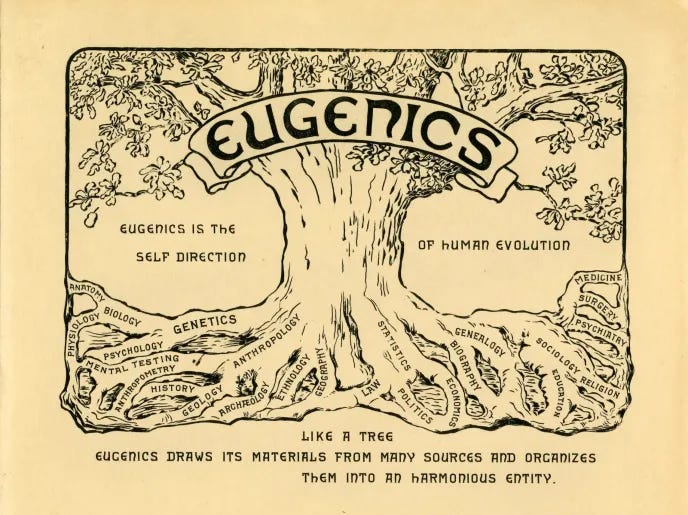
William Shockley revived this nonsense in the 1960s. Robert Graham created a “Nobel sperm bank“ in 1980. Charles Murray (Harvard) proposed connections between race and intelligence in the 1990s. Nonsense, yet persisting because it is rooted in American myth.
The American Historical Association was founded in 1884. Its members contributed to the formalization of History as a foundational part of public education. This period coincided with (1) the growth of a centralized capitalist economy; (2) the establishment of Jim Crow segregation in the South; (3) the beginnings of the overseas American empire; (4) the end of the Indian wars and the “frontier”; (5) the shift of the population from rural to urban; and (6) the beginnings of massive immigration from Eastern and Southern Europe. All these factors become part of the new myth of a unified nation, along with its shadow narrative of genocide and slavery. The History profession arose from a view of progress that saw the historical sweep of the West in general and of American civilization in particular as an upward struggle of profound significance to humanity. (For more detail, see “The Myth of Progress” in Chapter Nine of my book Madness at the Gates of the City: The Myth of American Innocence).
In 1893 historian Frederick Jackson Turner (Harvard) argued that the settlement of the western frontier was decisive in forming a democratic culture distinct from Europe:
American democracy...was not carried in the Susan Constant to Virginia, nor in the Mayflower to Plymouth. It came out of the American forest, and it gained new strength each time it touched a new frontier. Not the constitution but free land and an abundance of natural resources open to a fit people, made the democratic type of society in America for three centuries while it occupied its empire.
Many believed that the end of the frontier represented the beginning of a new stage in American life and that the U.S. must expand overseas. Others viewed this as the impetus for a new wave of American imperialism. The equality and liberty promoted by western expansion was illusory, because it didn’t account for the spread of slavery westward, the broken Indian treaties, the Trail of Tears, the disenfranchisement of Mexican-Americans, the Chinese Exclusion Act, the expansion of poverty during the Gilded Age – or women. But the various metaphoric interpretations of “the Frontier” have continued to motivate politicians, popular histories, films and novels that characterize the West in terms of radical individualism and conquest of Native peoples.
PART THREE
For empires, the past is just another overseas territory ripe for reconstruction, even reinvention. – Alfred McCoy
History textbooks are not like other kinds of histories...written not to explore, but to instruct, to tell children what their elders want them to know about their country. – Francis FitzGerald
The purpose of education is to create in a person the ability to look at the world for himself, to make his own decisions...But no society is really anxious to have that kind of person around. What societies really want is a citizenry which will simply obey the rules. – James Baldwin
Education and schooling are mutually exclusive terms...Forced institutional schooling is absolutely unreformable because it is already an unqualified success. – John Gatto
Gatto, former New York State “Teacher of the Year”, described public education in America:
We don’t need Karl Marx’s conception of a grand warfare between the classes to see that it is in the interest of complex management, economic or political, to dumb people down, to demoralize them, to divide them from one another, and to discard them if they don’t conform...you needn’t have studied marketing to know that there are two groups of people who can always be convinced to consume more than they need to: addicts and children. School has done a pretty good job of turning our children into addicts, but it has done a spectacular job of turning our children into children.
Much later, millions of us are profoundly misinformed, despite our educational system. Or is it because of this system? In Chapter Five of my book, I compare indigenous initiation traditions to mandatory – that is, forced – public education and refer to Gatto’s book Dumbing Us Down: The Hidden Curriculum of Compulsory Schooling. The Social Darwinists and eugenicists who designed America’s educational system modeled it on that of the militaristic Prussian state. Gatto wrote:
... a system that reduced human beings during their malleable years to reliable machine parts, human machinery dependent upon the state for its mission and purpose...American scholarship during the 19th century was almost exclusively German at its highest levels... From 1814 to 1900, more than 50,000 young men from prominent American families made the pilgrimage to Germany to study under its new system of higher education based on research instead of “teaching.” Ten thousand brought back Ph.D.’s to a then-uncredentialed United States, preempting most of the available intellectual and technical work...Virtually every founding father of American compulsory schooling went to Prussia to study its clockwork schoolrooms firsthand...By 1905, Prussian-trained Americans like John Dewey were in command of every one of our new institutions of scientific teacher training: Columbia Teacher’s College, the University of Chicago, Johns Hopkins, the University of Wisconsin, Stanford.
Teacher training in Prussia was founded on three premises:
1 – The state is the only true parent.
2 – The purposes of schooling are obedience and subordination, rather than intellectual training. The best-known device to break the will, practiced for centuries among English and German upper classes, was early separation of parent and child. Public education was backed by the power of the state to guarantee that separation.
3 – Both the schoolroom and the workplace must be dumbed down into simplified fragments that anyone can memorize and operate. This solves the capitalist’s dilemma: a disobedient work force could be replaced quickly, without damage to production, if the workers required only habit, not mind, to function properly.
Since then, seven generations of children have endured a routine designed to restrain dissent and originality and reduce everyone to a uniform, standardized level. Gatto asked, “Could it be that our schools are designed to make sure that not one (child) ever really grows up?”
It wasn’t always this way, writes John Michael Greer:
Before then, education was less rigid and more successful. In the U.S., the classic one-room schoolhouse was common. One teacher supervised the process; a half dozen older students, who served as assistant teachers...and children aged seven to fifteen, who worked at their lessons alone or in little groups and got help from the teacher and her assistants. It followed the familiar model of group work on harvests and quilting bees; it was busy, disorderly, and remarkably effective, and it made literacy and general knowledge about the world all but universal in mid-19th century America.
This system produced 5th-grade math books that, wrote Gatto, “were pitched then on what would today be considered college level”. By the 1890s, however, many were demanding schoolbooks that would bind the nation together and minimize sectional differences. Reconciliation meant a reunion of whites everywhere that rejected both racial equality and a strong central government that might enforce civil rights. Publishers responded by minimizing discussion of slavery.
Others were demanding education to serve the needs of capitalism. This meant separating children by age into different classrooms and drilling them in endless repetitive lessons. Greer continues:
The goal of the new education was to manufacture interchangeable parts for the economy out of the utterly non-interchangeable raw material of young human beings. That’s why schooling is as dreary as it is. The boredom is an essential part of the process of getting children used to the stunning monotony of labor in a modern industrial economy…finding ways to force children down to the lowest common denominator...
Writing is subject to the same constraints. Most employees in a modern industrial society don’t need to write. Of those who do, most only need to be able to write a business letter or an interoffice memo. What’s more, a nation full of people who can use written language freely, to express whatever they want to express, is a danger to the status quo...the entire way in which writing is taught in American schools is set up to make children hate and fear the act of putting down their thoughts…such an exercise in misery that once schooling is over, writing is nearly the last thing you want to do...the education machine succeeds in its purpose.
What was – and remains – that purpose? As public education evolved, it had two specific goals: (1) to make and keep the young only as literate and skilled as necessary for the capitalist economy, and (2) to teach political loyalty in a time when religion was being replaced by nationalism. Historian William Laprade stated that the function of history in the schools was “inculcation of patriotic religion.” Ellwood Cubberley (Dean, Stanford Education) admitted:
Our schools are...factories in which the raw products are to be shaped and fashioned...And it is the business of the school to build its pupils according to the specifications laid down.
Quoting from early texts, Gatto distills schooling’s intent into six functions:
1 – Adjusting: establishing fixed habits of reaction to authority to preclude critical judgment.
2 – Integrating: making people as alike as possible.
3 – Diagnosing: determining everyone’s proper social role.
4 – Differentiating: sorting children by role and training them “only so far as their destination in the social machine permits.”
5 – Selecting: identifying the unfit at an early age.
6 – The propaedeutic function: teaching a minority to manage the rest, who are “deliberately dumbed down and declawed...”
Richard Hames writes that everything was planned toward these ends:
Before a child learns a single verb or theorem, the school teaches something more durable and more damaging: that knowledge has edges, that curiosity has a timetable, and that the self must be subdued before learning can begin. This lesson is delivered not by any teacher but by the architecture itself – the rows of identical desks facing a single point of authority, the bell that ends thought mid-sentence, the corridor that enforces silence precisely where conversation would be most alive.
An industrializing economy required workers who could follow instructions, arrive on time, tolerate repetition, and accept hierarchy...The school was designed to produce exactly that. It sorted children into ability streams the way a factory sorted raw materials by grade. It measured outputs against standardized criteria because uniformity was what the production line required. It rewarded those who could suppress their individual curiosity...a machine doesn’t stop to ask questions.
Schooling, after a few generations, left children vulnerable to marketing, which ensured that they would grow older but never grow up.
In 1907, Wilson, then president of Princeton (which would refuse to admit black undergraduates for another forty years), announced: “...the manufacturer insists on having the world as his market...The flag of his nation must follow him, and the doors of nations which are closed against him must be battered down”. In 1909 he told teachers, “We want one class of persons to have a liberal education, and we want another class...a very much larger class...to forgo the privilege”.
From that point (when the system was installed universally), literacy began to decline from nearly 100% to a point when, in 1973, functional illiteracy kept 27% of men from military service. Later, claimed Gatto, “40% of blacks and 17% of whites can’t read at all.” Now, 45 million adults are functionally illiterate and 42% of college students never read a book after graduation.
Meanwhile, as a growing Catholic population desired history books that were less steeped in Protestant prejudices, their presses began issuing books for parochial schools. By the 1920s, some large publishers were producing books that were acceptable to Catholics, while others were appeasing Southerners. An exception, An American History (1911) by David Muzzey (Columbia) became a standard text until it came under fire during the 1919 Red Scare when conservatives attacked it as subversive.
In 1925, the Tennessee “Scopes Monkey Trial” highlighted religious attacks on evolution. That state’s Butler Act (not repealed until 1967) banned teaching “any theory that denies the story of the Divine Creation of man as taught in the Bible.” During that decade, 37 bills were introduced in 20 states to prohibit the teaching of evolution.
Much later, James Loewen wrote:
Textbook authors need not concern themselves unduly with what actually happened in history, since publishers use patriotism, rather than scholarship, to sell their books…the requirement to take American History originated as part of a nationalist flag-waving campaign early in the (20th) century…Many history teachers don’t know much history: a national survey in 1990 revealed that 13% had never taken a single college history course.
The situation might well be worse if they had studied history in college. Despite 1960s stereotypes, the more educated a person is, the more likely they are to support America’s imperial wars.
Students at all levels read what local gatekeepers want them to read, if they can read at all. We’ve all seen statistics about ignorance of basic facts in America.
Abraham Lincoln was born in a log cabin which he built with his own hands. – American college student.
Teach a child to read, and he or her will pass a literacy test. – George W. Bush (Yale)
PART FOUR
Memory says, “I did that.” Pride replies, “I could not have done that.” Eventually, memory yields. – Frederick Nietzsche
Every empire has said that it is not like all the others, that its circumstances are special, that it has a mission to...bring order and democracy, and uses force only as a last resort. And there always is a chorus of willing intellectuals to say calming words about benign or altruistic empires, as if one shouldn’t trust the evidence of one’s own eyes... – Edward Said
History is not an exact science, but a means of explaining the present in terms of the past... Propaganda aims at the opposite, explaining the past in terms of the present; a great deal of historical writing is propaganda. – Basil Davidson
We return to our main theme, the history of history.
Immediately after the Civil War, Edward Pollard’s The Lost Cause: A New Southern History of the Confederates portrayed the Old South as a multicultural paradise of racial harmony untouched by the evils of industrial capitalism. It recast the struggle to perpetuate slavery as a noble defense of a traditional way of life, led by gallant gentleman-officers and fought by loyal soldiers in the “War of Northern Aggression” (it ignored the facts that Southern soldiers were draftees and that tens of thousands had deserted).
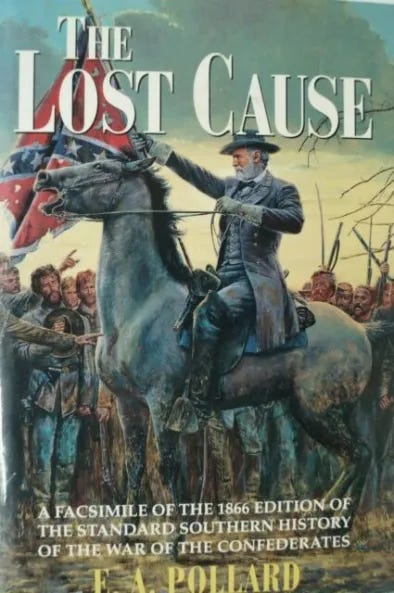
Within two generations, most white Americans remembered the war as one “between brothers”, fought over states’ rights rather than slavery. And they believed that blacks hadn’t been ready for freedom because, as one preacher wrote, the former slaves couldn’t “sacrifice their lusts.” By 1900, descendants of the Confederate aristocracy were in complete control of the racial narrative, as I write here.
The United Daughters of the Confederacy, founded in 1894, erected 700 monuments to the Lost Cause (most of them in the 1950s, to counter the Civil Rights movement).
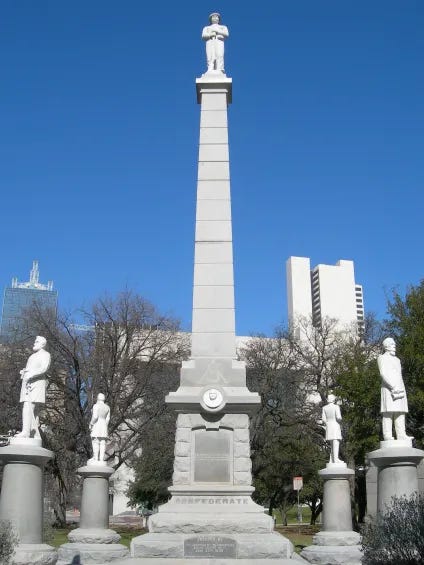
But their most effective tool was propaganda: ensuring that Southern schools used only history books that defended slavery and praised the Ku Klux Klan, and banning those books that didn’t. The 1908 History of Virginia claimed, “Generally speaking, the negroes proved a harmless and affectionate race, easily govern-ed, happy in their condition.” Virginia: History, Government, Geography, used in seventh-grade classrooms into the 1970s, claimed, “Life among the Negroes of Virginia in slavery times was generally happy. They went about in a cheerful manner...” A high school textbook claimed:
He did not work as hard as the average free laborer since he did not have to worry about losing his job…food was plentiful, his clothing adequate, his cabin warm, his health protected, his leisure carefree.
Greg Huffman estimates that seventy million students were enrolled in the South’s public schools between 1889 and 1969. All of them were subjected to this version of history. And the South exerted great influence on Northern publishers as well, who
…had decisions to make if they wanted to sell books to Southern schools. Go all in with Lost Cause dogma and…sell the book only in the South? Or have two versions of the same book – one with…watered-down history for the South, and another one with historical facts for every-one else? The latter was often the choice.
Mississippi schools used Lost Cause-themed textbooks exclusively until a federal court forced them to stop in 1980.
But we need to understand the teaching of Lost Cause mythology in the North, where most intellect-uals still accepted white supremacy. Donald Yacovone surveyed 3,000 textbooks that they wrote and concluded:
For the most part, the textbooks from the pre-Civil War period through the end of the century followed a basic format: They would go from exploration to colonization to revolution to creation of the American republic, and then every succeeding presidential administration. Anything outside of the political narrative was not considered history and was not taught.
As recently as the 1940s,
…positive assessments of slavery in American history textbooks, which taught that the African American’s natural environment was slavery, where they were cared for from cradle to grave…They dismissed slave narratives as propaganda, downplayed the history of Africans before slavery, and ignored the work of African American scholars…
Again, much of this deadly nonsense centers around Wilson, the only president with a PhD (in History – and who would later become the American Historical Association’s president), and even by the standards of his time, a racist. In 1915 he showed the film Birth of a Nation in the White House, making it the first mega-hit.

Depicting heroic whites rescuing young women from the clutches of their drooling black abductors, it quickly led to a massive resurgence of the KKK. Earlier, Wilson had written of Reconstruction:
…the dominance of an ignorant and inferior race was justly dreaded…The white men were roused by a mere instinct of self-preservation – until at last there had sprung into existence a great Ku Klux Klan, a veritable empire of the South, to protect the Southern country.
On immigration, he contrasted “the men of the sturdy stocks of the north” with “the more sordid and hopeless elements” of southern Europe, who had “neither skill nor quick intelligence.”
It seems surprising that Wilson has been consistently ranked among the greatest of American presidents – unless we remember that, in Sheldon Stern’s words,
Wilson’s egregiously biased and largely fabricated “history” stands as a crude but entirely mainstream summary of the view of Reconstruction which dominated the American historical profession, as well as much of U.S. politics, education and society for decades.
Around the turn of the century, two forces contributed to what Peter Novick calls a “racist historio-graphical consensus”. One was the nationalistic fervor that was replacing religion, even in the South, as a unifying factor. The second was the unrepentant racism among intellectuals who taught Social Darwinism and Eugenics:
Professional historians...became as harshly critical of the abolitionists as they were of “irresponsible agitators” in the contemporary world, they accepted a considerably softened picture of slavery, and they abandoned theories of the “slave power conspiracy.” Above all, they joined with southerners in denouncing the “criminal outrages” of Reconstruction…
For another forty years, the “Dunning School” dominated the writing of post-Civil War history. It claimed that black suffrage had been a political blunder and that Republican state governments had been corrupt and unrepresentative. Historian Eric Foner condemns this perspective as
…not just an interpretation of history. It was part of the edifice of the Jim Crow system. It was a justification of taking the right to vote away from black people on the grounds that they completely abused it during Reconstruction…a justification for the white South resisting outside efforts in changing race relations…helped to freeze the minds of the white South in resistance to any change whatsoever…and justified decades of Northern indifference to Southern nullification of the 14th and 15th Amendments…historians have a lot to answer for in helping to propagate a racist system in this country.
William Dunning headed both the American Historical Association and the American Political Science Association. At Columbia, he taught U.S. history graduate students that blacks were incapable of self-government, that the North’s greatest sin consisted of relinquishing control of the Southern governments to “ignorant, half-civilized former slaves (who) had…no aspiration or ideals save to be like whites.” His influence was enormous.
His student Ulrich Phillips (Yale) claimed that slavery civilized “savage Africans”. His books remained the standard texts on slavery for decades. John Burgess (Columbia), wrote that “a black skin...a race of men which has never of itself succeeded in subjecting passion to reason.” George Beer (Colum-bia) wrote that “the negro race has hitherto shown no capacity for progressive development except under the tutelage of other peoples.” Other members of the school included James Garner (U. Illinois), William Davis (U. Kansas), J.G. Hamilton (North Carolina), Walter Fleming (Vanderbilt), Charles Ramsdell (Texas), Mildred Thompson (Vassar), the Holocaust denier Harry Barnes (Smith) and Ellis Oberholzer (U. Pennsylvania), who claimed that Yankees didn’t understand slavery because they “had never seen a nigger except Fred Douglass…Blacks were as credulous as children...”
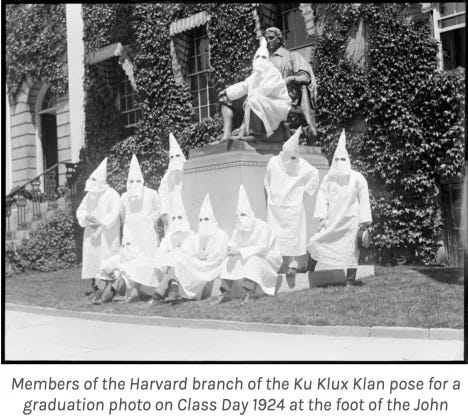
Phillip Bruce (Harvard) and Avery Craven (Harvard) supported slavery. Milo Quaife (Chicago) derided the “absurd doctrine of racial equality.” Ellis Coulter, who taught at Georgia for 60 years, founded the Southern Historical Association and edited the Georgia Historical Quarterly for fifty years, pontificated:
…most of the Negroes (would) spend their last piece of money for a drink of whisky…Black participation in government was a diabolical development, to be remembered, shuddered at, and execrated.
How do we explain such low ignorance in such high places? W.E.B. DuBois did so in Black Reconstruction, on Dunning and his followers:
The Columbia school of historians have issued 16 studies of Reconstruction, all based on the same thesis and all done according to the same method: first, endless sympathy with the white South; second, ridicule or silence for the Negro; third…concludes that the North...did a grievous wrong, but eventually saw its mistake and retreated.
Their books were:
…openly and blatantly propaganda…especially those by Ulrich Phillips…”The Tragic Era” by Claude Bowers (is)…absolutely devoid of historical judgment or sociological knowledge... every effort has been made to treat the Negro’s part in Reconstruction with silence and contempt…One fact alone explains the attitude of most recent writers toward Reconstruction: they cannot conceive of Negroes as men.
If we are going to use history for our pleasure and amusement, for inflating our national ego, and giving us a false but pleasurable sense of accomplishment, then we must give up the idea of history as a science and admit frankly that we are using a version of historic fact in order to influence and educate the new generation…It is propaganda like this that has led men in the past to insist that history is “lies agreed upon”.
Du Bois concluded:
...somebody in each era must make clear the facts with utter disregard to his own wish and belief. What we have got to know...are the things that actually happened in the world. Then with that much clear and open to every reader, the philosopher has a chance to interpret these facts; the historian has no right, posing as scientist, to conceal or distort facts; and until we distinguish between these two functions...we are going to render it easy for a muddled world out of sheer ignorance to make the same mistake ten times over.
That same year (1935), the editors of the 14th edition of the Encyclopedia Britannica asked him for an article on the history of the American Negro, but when he provided it, they deleted all references to Reconstruction.
Other Black historians (George Williams, John Franklin, Carter Woodson, Joel Rogers, John Clarke, C.L.R. James, David Lewis, Frank Snowden and Arnold Rampersad) tried to correct the record. However, no textbook mentioned any historian of color by name until 1950. And it wasn’t until 1956 that any white historian (Kenneth Stampp, in The Peculiar Institution), wrote of slavery from the perspective of the slaves themselves and seriously criticized Dunning’s ignorant racism.
While it may be true that “no one takes Dunning seriously anymore”, the context remains relevant. He and his followers taught dozens of men who became the heads of History departments into the 1970s. In other words, they taught the men who went on to teach America’s ruling class.
Henry Commager’s (Columbia) and Samuel Morison’s (Harvard) The Growth of the American Republic, read by generations of college freshmen, claimed that slaves “suffered less than any other class in the South…The majority…were apparently happy.”
Arthur Schlesinger Sr. (Harvard), suggested that high achievement among some blacks could only be the result of an “infusion of white blood.” Seymour Lipset (Harvard) wrote, “America has been a universalistic culture, slavery and the black situation apart” (my quotes). Jon Meacham received the Pulitzer Prize for his biography of Andrew Jackson, which covers the Trail of Tears in four paragraphs. Arthur Schlesinger Jr. (Harvard) also won the Pulitzer for The Age of Jackson, without mentioning the Trail of Tears at all.
One wonders how these men could produce high school-level prose without ever being questioned by their peers. Many years later, Howard Zinn would observe that such “sloppy generalizations… contribute to the common glorification of this country’s early years…(they) feed arrogance and dull the critical faculties…”
Of course, there were occasional exceptions. Harold Rugg’s high school social studies textbook series traced the evolution of American democracy in the face of pervasive social problems. But conservatives attacked it as subversive and removed it from schools in the 1940s.
PART FIVE
The overwhelming majority of information is classified to protect political security, not national security. – Julian Assange
History is a set of lies agreed upon. – Napoleon Bonaparte
There was no blacklist at the time. The only thing our side did that was anywhere near blacklisting was just running a lot of people out of the business. – John Wayne
One of the definitions of a Communist is a person that denies he is a communist. – Raymond Allen, President, U. Washington
There will be no witch-hunts at Yale because there will be no witches. We do not intend to hire Communists. – Charles Seymour, President, Yale, 1949
This crap should not be accepted for any credit…a terrible anti-American academic. – Mitch Daniels, President of Purdue University, on Howard Zinn
It’s not an unbiased account. So what? If you look at history from the perspective of the slaughtered and mutilated, it’s a different story. – Howard Zinn
Academics directed the narrative of American imperialism. Seven generations of schoolchildren have learned that the nation of extreme individualists is an individual among nations, the exceptional one, chosen by Divine Providence to redeem the world. Most of us – at least most white people – are still moved by this story, of which World War II is our most shining example. It drives our support for sanctions, coups and military intervention in Ukraine, China, Iran, Cuba, Chile, Venezuela, Colombia, Bolivia, Ecuador, Somalia, Sudan, Yemen, Angola, Guatemala, El Salvador, Nicaragua and countless other places.
To those outside our mythic bubble, however, this is a story that we regularly need to tell ourselves, to still our doubts that long-distance murder and theft of resources are moral acts. This helps explain why our gatekeepers – historians and journalists (25% of New York Times reporters attended Ivy League schools) – speak with one voice, as they have done in recent years concerning Julian Assange, Chelsea Manning and other whistle blowers, to condemn anyone who might question these stories. American myth is highly unstable, and questioning any one aspect of it can lead to skepticism about all of it.
Twentieth century historians claimed to be objective, even scientific. Yet during World War One, historians in all the combatant countries eagerly endorsed the war effort and proclaimed the unique goodness of their own countries. American university courses on the history of Western civilization taught that America was fighting to defend the progressive values of British and French colonialism.
Immediately after the war, the U.S. and twelve other nations attacked the Soviet Union. Afterwards, compliant intellectuals inverted history; Yale historian John Gaddis termed this unprovoked invasion a “defensive” action.
Years later, defending the “War on Terror”, Gaddis would claim that the borders of global civil society were being menaced by non-state actors in a manner similar to the “native Americans, pirates and other marauders” that had once menaced peaceful Americans. Foreign affairs writer Robert Kaplan would concur: “The War on Terrorism was really about taming the frontier”.
Between the wars, writes Novick, historians expressed widespread anti-Semitism. One professor warned Jewish graduate students that “History belongs to the Anglo-Saxons. You belong in economics or sociology.”
Letters of recommendation tried to reassure prospective employers: Oscar Handlin “has none of the offensive traits which some people associate with his race”...Bert Loewenberg “by temperament and spirit…measures up to the whitest Gentile I know”…Daniel Boorstin “is a Jew, though not the kind to which one takes exception”, and Richard Leopold was “a Jew, but a Princeton graduate, not the offensive type”…Solomon Katz was “quite un-Jewish, if one considers the undesirable side of the race”.
Academic Gatekeepers have controled the narrative of World War Two, both of how America got into it and how it ended. This is the myth of the Good War.
History begins as mythology – chronologies of kings – and often remains such, conveying narratives that serve the same function, reminding us of who we are, and who we are not. The social function of myth is to validate the social order. At this level of understanding, myth equals ideology plus narrative. Stories help us digest the ideology. Myths determine perception, like the lenses of a pair of glasses. They are not what we see, but what we see with. We can’t see outside our bubble (but outsiders can see us.) We give our attention to one set of possibilities rather than another, and our intentions and dreams follow. So, myth creates fact. Indeed, myth trumps fact.
We draw stories from our past and abstract them into evocative icons (the Alamo, Pearl Harbor) that contain the essential elements of our worldview. So obvious that they never have to be “explained”, they transform history into sacred legends that describe reality to us and prescribe our choices within acceptable limits. “Myth,” writes Richard Slotkin, “is history successfully disguised as archetype.” And, we add, history is often myth disguised as fact.
Curiously, if we add Custer’s Last Stand, the sinking of The Maine and 9-11 to that list, we find that most of these images are of our most famous defeats. This reflects the complex dance between the American Hero (or winner) and his shadow, the victim (or loser), that our mythology has described for 400 years. When the innocent nation once again is attacked by dark, evil men (as G.W. Bush said, they hate us for our freedoms), we are justified in responding with Biblical ferocity, as we did to the Japanese – the racialized Other – much more so than to the Germans.
From the very beginning, history and myth intersect throughout the story of America, and it’s almost impossible to tease out the differences. But let’s be clear about this: we’re not simply talking about lies, distortions, omissions and propaganda. That refers to “myth” in the lesser meaning of the term. We are talking about why we frame our stories about ourselves in the way we do, and why we utilize them to re-stabilize the crumbling building blocks of our collective self-image.
Franklin Roosevelt had decided by 1940 on the necessity of defeating Germany. But to overcome domestic anti-war sentiment he needed to lure the Japanese (whose codes had been broken and whose intentions were well known) into attacking Pearl Harbor, after which treaty obligations would force the Germans to declare war on the U.S.
But every American knows that America suffered a surprise attack at Pearl Harbor, was drawn into the war reluctantly and only then proceeded to save the world from evil. Only fighting when provoked is a bedrock aspect of our national mythology. It provides the essential energy of disillusioned innocence that has propelled the nation into every war since the U.S. invaded Mexico – and, for 200 years before that against Native Americans.
Historians have long been charged with maintaining this narrative and ostracizing those who question it. To understand what the gatekeepers can do, consider Charles Beard, who, like Dunning, served as president of both the American Historical Association and the American Political Science Association. Andrew Bacevich writes:
…Beard stood alone at the pinnacle of his profession. As a historian and public intellectual, he was prolific, influential, fiercely independent, and equally adept at writing for scholarly audiences or the general public.
Survey books talk about how influential Beard was in the 1920s and 1930s. Few mention what he wrote after the war. In 1947, he received a gold medal for the best historical work of the preceding decade. But that same year he published President Roosevelt and the Coming of the War, which accused FDR of lying to the nation. He also revealed (in “Who’s to Write the History of the War?”) that the Rockefeller Foundation had subsidized an official history of how the war had come about. Yes, writes Gary North,
...the victors always write the history books, but when the historians are actually policy-setting participants in the war, the words “court history” take on new meaning.
Indeed, some of those who wrote such histories attained high government positions, and many of them, including Admiral Samuel Morison, savagely attacked Beard as an isolationist and an old fool. They quickly and permanently destroyed his reputation because he had committed the grave sin of questioning the “Good War” narrative, or in current terms, of promoting a conspiracy theory. Morrison, writes Jesse Lemisch, claimed that Beard and others
…had taught that no war was necessary and no war did any good…they should have pointed out that war does accomplish something, that war is better than servitude...The years from 1920 to 1940 were “woeful decades” when historians were robbing the people of their heroes ...insulting their folk-memory of great figures…they had “repelled men of good will and turned other men, many not of good will, to communism”...The historian should cooperate with “patriotic and ancestral societies such as...Daughters of the American Revolution and Daughters of the Confederacy”...the ludicrousness of an admiral wrapping himself in the mantle of objectivity while haranguing his audience on the glories of war...
Beard died in 1949. His book on Roosevelt quickly went out of print and was not reprinted until 2003. Today the public has forgotten him, although Robert Stinnett’s book Day of Deceit confirms that Roosevelt provoked the Japanese to attack. Within the profession, Beard remains a reviled and discredited figure. North writes:
This is why there are no tenured World War II revisionists who write in this still taboo and well-policed field. The guild screened them out...What the guild did to Beard (and others) posted a warning sign: Dead End.
The other half of the “Greatest Generation” myth conveyed by most historians is why the U.S. dropped the atom bombs. However, Gar Alperovitz has shown that the U.S. didn’t need to drop the bombs, that the mass atrocities had much more to do with the approaching confrontation with the U.S.S.R. Read more, here, here and here. Later, President Eisenhower admitted, “The Japanese were ready to surrender and it wasn’t necessary to hit them with that awful thing”.
The true narrative of the war has many accounts of unnecessary atrocities that the Allies committed, and the lies that justified them. Zinn tells of two such crimes that he personally participated in as a bombardier: the bombings of Plzen, Czechoslovakia and Royan, France.
Still, most Americans hold to the story that the Exceptional Nation fought the Good War reluctantly and ended it with humanitarian motives. Bacevich concludes:
Americans have become so imbued with this narrative as to be oblivious to its existence. Politicians endlessly recount it. Television shows, movies, magazines and video games affirm it...the public accept it as unquestionably true...the Good War narrative survives fully intact. For politicians and pundits eager to explain why it is incumbent upon the U.S. to lead or to come to the aid of those yearning to be free, it offers an ever-ready reference point...
In that sense, the persistence of the Good War narrative robs Americans of any capacity to think realistically about their nation’s role in the world. Instead, it’s always 1938, with appease-ment the ultimate sin to be avoided at all costs. Or it’s 1941, when an innocent nation subjected to a dastardly attack is summoned to embark upon a new crusade to smite the evildoers. Or it’s 1945, with history calling upon the U.S. to remake the world in its own image.
Or it’s 1991, with mass support for invading Iraq. Or it’s 2022, with liberal congresspersons unanimously supporting $65 billion – more than Russia’s entire military budget – to prolong the war in Ukraine.
Postwar historians, whether liberal or conservative, encouraged an overwhelmingly affirmative and celebratory stance toward the American experience, in five basic themes.
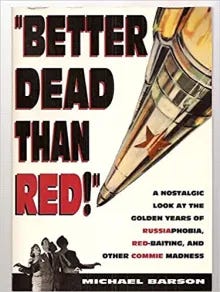
The first was nearly universal justification of the cold war and the development of government-supported social science research which assumed that the nation’s foreign policy consistently promoted peace, freedom and free enterprise. But it was also a time of anti-communist hysteria. “The purpose of propaganda,” writes psychologist Sam Keen, “is to paralyze thought, to prevent discrimination, and to condition individuals to act as a mass.” America’s media, universities and churches quickly converted post-war optimism into hysteria.
Americanism of the 1950s now had a “higher power” (the state), dogma (anticommunism), zealots (the F.B.I.), modes of excommunication (the Hollywood blacklist) and clergy. In this sense, it can be called a negative ideology, of mere opposition to or fear of another way of thinking. Or we could call it a religion of denial because it allowed nuclear bellicosity, neo-colonialism and racial segregation to coincide with the ideals of freedom and opportunity. Millions resolved this dilemma by accepting the unrelenting propaganda – to be American was to be anticommunist. “If Americans could only band together against the common red foe,” wrote Kovel, “they would know who they were.”
As in 1692 Salem, one could save oneself by naming names. Americans supported security measures that the government (as it would in 2001 and later) claimed were necessary to protect democracy. In 1954, 78% agreed to report neighbors as suspected Communists. Some 2,700 federal workers were fired and 12,000 resigned. Six hundred college instructors were purged. Lemisch writes:
Tenure made no difference…How could liberals speak out for academic freedom while firing those who tried to assert their freedom?...academic thought grew slovenly and stultified in its one-sidedness.
Ellen Schrecker, author of No ivory tower: McCarthyism and the Universities, writes:
The government administered the first stage of McCarthyism, acting through the agency of investigating committees and the FBI to identify political undesirables on campus. It let the universities handle the second stage and get rid of them…The academy did not fight McCarthyism. It contributed to it…punishments far more severe than any Joe McCarthy was capable of inflicting were meted out to dissenters in quiet, dignified tones by men who would have been shocked to have their names linked with that of the coarse demagogue.
In 1953 the Association of American Universities stated that Communist Party membership “extinguishes the right to a university position”. Professors were to cooperate with legislative inquiries. Most suspects had joined the Communist Party in the 1930s and had long since left it. But unless they were willing to turn informer, they were still fired.
In the 1960s, gatekeepers resorted to cheap psychologizing of campus radicals. Arthur Schlesinger, Jr. called them “lonely and frustrated people”. Resistance to elite leadership was rooted in “envy of superior persons.’‘ Psychiatrist Bruno Bettelheim (U. Chicago) described student activists as “paranoiacs...having to beat down father to show they are a big boy.” Daniel Boorstin (U. Chicago) saw them as “dyspeptics, psychotics.” Nathan Glazer (Harvard) compared Berkeley’s Free Speech Movement to Lee Harvey Oswald, while Seymour Lipset (Harvard) likened it to the Ku Klux Klan. Sociologist Louis Feuer (Berkeley) attacked the student movement:
...a magnet for the morally corrupt; intellectual lumpen-proletarians, lumpen-beatniks, and lumpen-agitators wend their ways to the university campus to advocate a mélange of narcotics, social-perversion, collegiate Castroism and campus Maoism.
Just as they had in the 1950s, universities had intellectual justification for firing activist faculty and students. In the 1968-1969 academic year, over 900 students on 28 campuses were expelled or suspended for political offenses and 850 were put on probation. It was revealed, however, that two influential anti-communist groups, Americans for Democratic Action and the Congress for Cultural Freedom, were underwritten by the CIA.
Since then, says Chomsky, intellectuals have emphasized negative aspects of the Sixties: “… naturally it has a very bad name – because they hated it.”
And all this could still arrive along with the sloppy writing and generalization that only tenured professors can get away with. Ernest May (Harvard), who would later advise the 9/11 Commission, wrote of the Spanish-American War: “American public opinion had frenziedly demanded war.” Zinn responded that in 1898 “…there were no ways of testing general public opinion…the frenzy was mostly the fulminating of a few important newspapers.” Is this a silly example? Only if we don’t realize that May was actually offering a historian’s rationale for current warmongering:
Such a generalization obscures the way decisions for war are made by a handful of men at the top, and the way public opinion is manipulated…to build support for it.
The second theme was specialization and escape into trivia. Zinn criticized 1960s academics who held such beliefs:
…disinterested scholarship…objective study…scientific method...the fear that using our intelligence to further our moral ends is somehow improper…the university becomes a play-pen in which society invites its favored children to play...to keep them out of trouble…The larger interests are internalized in the motivations of the scholar: promotion, tenure, higher salaries, prestige…There is no question of a disinterested” community of scholars, only a question about what interests scholars serve.
This reinforced the third theme. Academics were still colluding in the nation’s refusal to address its original sin of racism. Zinn discovered that from 1960 to 1966, of 3,265 dissertations in modern history, eighteen dealt with race. Of 446 articles in The American Historical Review from 1945 to 1968, five dealt with race.
Worse, some who did address the issue claimed that objective science supported their conclusions. As recently as 1974, Robert Fogel and Stanley Engerman used bogus “analysis” to argue that slaves lived as well as did free urban laborers. They claimed that slaves were whipped infrequently, but they used subjective reports from one plantation.
Schultz writes that by the late 1970s, economic crises gave politicians excuses to reshape higher education in the corporate image. They slashed funding, replaced grants with loans (tethering graduates to decades of debt) and spoke of “customers” and “products.” Administrative positions multiplied, often staffed by people with business rather than academic backgrounds. No longer was higher education seen as a public good, but as a private benefit shifting costs to student-customers.
Tenure lines were frozen, replaced with contingent faculty who were cheaper and easier to control. Professional programs, especially MBAs, exploded, not because of student demand but because corporations demanded a steady supply of trained managers. Naming rights for business schools and sports facilities cemented the symbolic merger of university and corporation...The result was an institution that still claimed the rhetoric of the Enlightenment but had fully adopted the operating system of corporate capitalism.
Meanwhile, as recently as 1980, seventh-grade Virginia students were still enduring the textbook Virginia: History, Government, Geography, which claimed that “Life among the Negroes of Virginia in slavery times was generally happy. The Negroes went about in a cheerful manner...”
The fourth theme is that anti-communism (like its child, the war on terror) was conducive to mendacity. In 1948, historian Thomas Bailey (Stanford) admitted,
... because the masses are notoriously short-sighted, and generally cannot see danger until it is at their throats, our statesmen are forced to deceive them into an awareness of their own long-run interests...
The fifth theme was good old-fashioned ignorance. As a Harvard undergraduate in the early 1960s, Richard D. Wolf wrote many history term papers, most of them receiving A-grades. The papers, he writes, were immature re-workings of Marxism. But his instructors, tenured History professors, had been so ignorant of Marx that they would marvel at the “unique” insights that Wolff, later to become an Economics professor, had offered.
The D.A.R. helped blacklist 170 textbooks that did not sufficiently reflect Christian and anti-communist values. African American history, such as the work of Lawrence Dunbar Reddick, remained on the margins, and most universities still excluded blacks from teaching positions. Meanwhile, many whites, including the future war criminal Henry Kissinger, entered the revolving door circuit between academia, media, business and government. Novick writes:
“Intellect has associated itself with power as perhaps never before in history,” Lionel Trilling observed in 1952. With the exceptions of physics, it would be difficult to think of any academic discipline which, during World War II and the cold war, participated more wholeheartedly in that association than did History.
Henry Steele Commager (Columbia), the critic of McCarthyism and conspiracy theories, saw few people, ‘’outside of Russia and her satellites,’‘ who looked with misgivings on the prospect that America should “control the course of world history in the second half of the twentieth century.”
But the sixties saw a new generation of politically active historians including Zinn (who published Vietnam: The Logic of Withdrawal in 1967 when few intellectuals were opposing the war), Lemisch, Herbert Apthecker, Page Smith, William Appleman Williams (“One of the central themes of American historiography, is that there is no American Empire”) and Staughton Lynd. They promoted “history from the bottom up”, which brought all subjects, especially minorities and women, more fully into the discipline. They challenged the elitist traditions of academic historical writing, especially the consen-sus that had grown out of the repressive atmosphere of the Cold War. New approaches freed from nationalistic hagiography emerged: comparative history, social history, oral history, psychohistory, women’s history, Black history and Chicano history.
The interdisciplinary field of American Studies was founded during the Cold War with about 300 members. But by 1967, it was emphasizing the study of race, class, gender and empire. In 2000, the American Studies Association would grow to 5,000 members, with 2,200 libraries subscribing to its journal American Quarterly.
For Peter Carroll this was a process of disillusionment, awakening and self-exiling:
We did not invent new facts; they had always existed. But we had been trained not to see them…an academic orthodoxy that defined American history from the perspective of the prevailing leadership. I no longer believed in that history. But what was I to do? I could switch sides and battle from within the institution – or I could step outside.
Lemisch exposed this nationalistic history, allegedly “politically neutral”, that, whether liberal or conservative, was always anti-communist. He showed that historians who led the anti-radical hysteria of the 1950s continued to do so later, attacking the New Left. The organization of the profession into a self-policing group played a significant role in the closing of the university community to radical voices. After the 1960s the culture wars began again. In 1974 schools in West Virginia included works by Eldridge Cleaver, Arthur Miller and George Orwell. But opponents firebombed schools, beat journalists and shut down the school system.
Zinn’s People’s History of the United States appeared in 1980. He wrote that there was,
…an inevitable taking of sides which comes from selection and emphasis in history…between conqueror and conquered, master and slaves, capitalists and workers, dominators and dominated in race and sex…victims and executioners, it is the job of thinking people, as Albert Camus suggested, not to be on the side of the executioners.
Much later, a handful of editors (the ultimate gatekeepers) associated with a small number of scholarly journals still retain the capacity to decide which work will be disseminated to the broader historical profession. Thomas Schofield writes:
...although the radical voice on campus is far from silent, there is abundant evidence of attempts to suppress it. The radical teacher knows that someone in his class is taking notes for the FBI…The sociology and politics of the academic world – which views are rewarded, which penalized, who is fired and who is hired – directly affect our view of America’s past and thus of its present and future.
Centrist historians usually ignored these radicals. For example, a recent introduction to historiography (the writing of history) mentions Lemisch once, and Noam Chomsky (not a historian but certainly a major voice) not at all. It mentions Beard, but not his marginalization. An online list of 269 “Famous American Historians” completely omits Zinn, the world’s most widely read historian.
When ignoring alternative voices is impossible, gatekeepers resort to sarcasm. For example, Yale historian Steven Gillon dismisses the film JFK by using simple but patronizing modifiers:
…the House Committee came to the bizarre conclusion that there was a second shooter on the grassy knoll, and that shooter fired at the President, but missed…In 1991, filmmaker Oliver Stone tapped into these doubts, and added his own paranoid twist...
Even before the Internet and social media, however, people wanted history that acknowledged what they could see with their own eyes. It was obvious how the U.S. had raped Viet Nam, and they wanted context. Forty-six years after its publication, A People’s History has exceeded four million copies in the U.S. edition alone. Over 100,000 teachers have registered with the Zinn Education Project. And, writes Peter Kirstein,
While Zinn’s reputation is derived from his writings and actions during Civil Rights and the antiwar movement, his courageous but frequently overlooked career-long demand for academic freedom and securing basic rights for faculty, students and staff is also significant …No other historian, and only a few academics such as Noam Chomsky, commanded such influence during the uprising against the war.
Despite their criticisms and attempts to marginalize him, Zinn (who’d been fired without warning at Spelman for his activism) finally attained tenure at Boston University in the mid-1960s, despite remaining an active anti-war voice. You can read about how it happened here: Howard Zinn and the Academic Gatekeepers.
Other critics of the empire, especially anti-Zionists such as Steven Salaita and Norman Finkelstein, remained vulnerable to arbitrary dismissal for alleged antisemitism. Meanwhile, academics Alan Dershowitz and Joan Peters freely published Zionist garbage, weapons company executives served as board members for dozens of museums, cultural organizations and universities, and southern universities still required loyalty oaths.
Some academics have been so determined to marginalize Zinn that they’ve written entire books, such as A Patriot’s History of the United States and Debunking Howard Zinn: Exposing the Fake History That Turned a Generation against America:
Propaganda…dishonest…factor in Americans’ turn away from their heritage of freedom toward communist fantasies…convincing a generation that the nation Abraham Lincoln truly called “the last best hope of Earth” is essentially a racist criminal enterprise built on murdering Indians, exploiting slaves, and oppressing the working man.
Gatekeepers write books criticizing how other historians write history. Richard Cohen’s Making History has been praised as “supremely entertaining” (New Yorker) and “exceptionally well-written” (Library Journal). He mentions Zinn only to note a 2012 contest determining People’s History to be the 2nd least credible history book in print. Michael Kammen’s (Cornell) The Past Before Us (1980) acknowledges the phrase “from the bottom up” but mentions Genovese and Lemisch only in footnotes and Zinn, once again, not at all. When gatekeepers do acknowledge him, their criticisms follow two themes:
1 – He was too left-wing for decent academics. The sole mention of him on the History Today website attacks People’s History with this gem:
Among the (otherwise entirely noble) contributors are several known Communist agents, a pederast, a terrorist and two men involved in a bloody prison revolt.
2 – While Zinn was acceptable for idealistic teenagers, wrote Jill Lepore (Harvard), he was not (like them!) a serious scholar; he was not objective or dispassionate. Worst of all, he was “politicized” and had “contempt for society’s elites”. David Greenberg (Yale) sniffs:
Zinn was saying that Big-Time History – with its formidable air of authority, its footnotes and archival documentation, its vetting by expert scholars – had really just served to shore up the power of established elites and put down stirrings of protest.
Well, yeah…Clement Lime responds: Greenberg doesn’t hate Howard Zinn because he was a bad scholar, but because he was a radical”.
Zinn also responded: “Holding certain fundamental values does not require that historians find certain desirable answers in the past, it just turns their attention to certain useful questions”. He opened the door in ways that earlier revisionists had not. Since A People’s History, dozens of histories “from the ground up” have appeared, even if few of their authors have attained anywhere near his influence. I’m proud that Zinn blurbed my book.
In a 2002 episode of The Sopranos, Anthony Jr mentions Zinn’s view that Columbus enslaved indigenous West Indians, only to be corrected his father: “He was a brave Italian explorer. And in this house, Christopher Columbus is a hero. End of story”.
Eventually, Trumpus rose to power partially by attacking DEI programs, critical race theory and “woke” professors. This culmination of decades of backlash combined the resentment of non-college-educated voters with the elites’ desire to further corporatize universities. Forty years after the publication of A People’s History, the “1776 Commission” denounced Zinn as a dangerous propagandist who, along with the 1619 Project, was corrupting the country’s young by making “students ashamed of their own history.” The purges have continued into 2026. In top universities, says historian Rashid Khalidi, it is now impossible to teach about genocide in Palestine.
But it’s also impossible to ignore Zinn, who, in addition to his scholarly work, wrote plays:
They are all proclaiming that my ideas are dead! It’s nothing new. These clowns have been saying this for more than a hundred years. Don’t you wonder: why is it necessary to declare me dead again and again? – “Marx in Soho”
Chico Marx put it even more plainly: Who you gonna believe, me or your own eyes?