Why does the The Night They Drove Old Dixie Down continue to move us over fifty years after The Band first recorded it?
The fact that many people continue to debate its meaning online is a mirror of America’s ongoing uncertainty about the resolution of the Civil War and its meaning for our time. The war – and the Viet Nam war during which The Night was composed – are still not over.
Music critic Ralph Gleason wrote:
Nothing I have read…has brought home the overwhelming human sense of history that this song does...It’s a remarkable song, the rhythmic structure, the voice of Levon (Helms) and the bass line with the drum accents and then the heavy close harmony in the theme, make it seem impossible that this isn’t some traditional material handed down from father to son straight from that winter of 1865 to today. It has that ring of truth and the whole aura of authenticity.
The lyrics may play a bit loose with the facts, but we’re talking about emotional authenticity. And for this reason, The Night has always been a challenge for progressives and anti-racists, because it forces us to consider the internal experience of an enemy, into a confrontation between our politics and our innate empathy for human suffering.
In a mere three verses, the song evokes a fundamental and ambiguous aspect of American myth, the war of brother against brother. And this directs us to a similar conflict within every soul. Every American is – or should be – struggling with the paradox of identity, between our national ideals and the realities of our actual behavior in the world.
But it condenses this tragic nature into the story of one Confederate veteran, Virgil Caine, who makes no claim for anyone else, a man who is clearly too poor to have ever owned slaves. Indeed, The Night never mentions race, slavery, state’s rights or the issue of secession. He simply wants us to understand, writes Greil Marcus, “…that the war has cost him everything he has.”
It is hard for me to comprehend how any Northerner, raised on a very different war than Virgil Caine’s, could listen to this song without finding himself changed. You can’t get out from under the singer’s truth – not the whole truth, simply his truth – and the little autobiography closes the gap between us. The performance leaves behind a feeling that for all our oppositions, every American still shares this old event; because to this day, none of us has escaped its impact. What we share is an ability to respond to a story like this one.
In the first verse we learn:
Virgil Caine is my name, and I served on the Danville train
Till Stoneman’s cavalry came and tore up the tracks again
In the winter of ‘65 we were hungry, just barely alive
By May the 10th Richmond had fell, it was a night I remember oh so well.
Chorus:
The night they drove old Dixie down and all the bells were ringing
The night they drove old Dixie down and all the people were singing
They went, Na na na nana na, nana na na na nana na na…
The repetition of that sound – “Na” – fifteen times evokes the preverbal wail of an innocent toddler who cannot possibly comprehend the disappearance of their mother.
Caine remembers the winter of 1865, a few months before the end of the war, when his unit unsuccessfully attempted to stop Union General Stoneman’s scorched earth strategy of destroying all crops and resources (he tore up the tracks again) that might have enabled the Confederacy to defend its capital. The Richmond and Danville Railroad was the main supply route into Petersburg, where the Confederate Army was protecting Richmond. Historian Bruce Catton writes,
Grant’s instructions were grimly specific. He wanted the rich farmlands so thoroughly despoiled that the place could no longer support a Confederate army; he told (General) Sheridan to devastate the whole area so thoroughly that a crow flying across the Valley would have to carry its own rations…Few campaigns in the war aroused more bitterness than this one.
Even though Stoneman, on the surface, may appear to be just a footnote in the history of the Civil War, in that part of the U.S. where the borders of Tennessee, North Carolina & Virginia meet, his name lives in infamy. The exploits of his plundering troops in the last days of a defeated Confederacy are still a part of local legend.
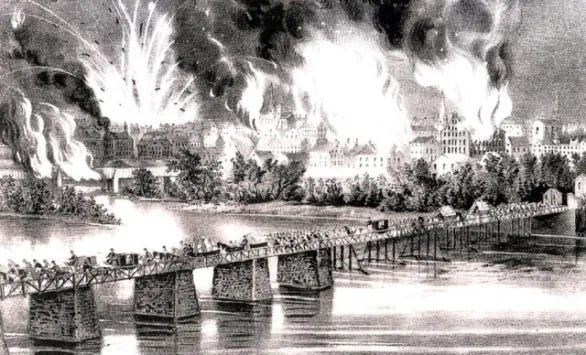
The siege of Richmond lasted ten months. It fell in early April, not in May, as Virgil sings. Perhaps his memory isn’t clear, even though “It’s a time I remember oh so well” (there is considerable debate about this). Before retreating, the Confederates set the city on fire to deny Union troops any usable resources. Many died in the fire. This is why “all the bells were ringing”. The civilian population, crowded with refugees, was starving.
Can we – are we willing to – imagine the suffering? Does it matter that these people had supported a cruel and unjust system? Does it matter that Americans then and now often refuse to experience grief and turn it into denial, resentment and racialized victimization, averting our eyes from the ongoing genocide in Gaza?
A full assessment of that moment must include the African American voice. Garland White was chaplain to the 28th Indiana Colored Volunteers, the first Federal soldiers to enter the burning city:
A vast multitude assembled on Broad Street, and I was aroused amid the shouts of ten thousand voices and proclaimed for the first time in that city freedom to all mankind...the doors of all the slave pens were thrown open, and thousands came out shouting and praising God, and Father, or Master Abe, as they termed him…We made a grand parade through most of the principal streets, beginning at Jeff Davis’s mansion, and it appeared to me that all the colored people in the world had collected in that city for that purpose…The excitement at this period was unabated, the tumbling of walls, the bursting of shells, could be heard in all directions, dead bodies being found, rebel prisoners brought in, starving women and children begging…I was with them, and am still with them, and am willing to stay with them until freedom is proclaimed throughout the world.
But suffering is suffering. “Back with my wife in Tennessee”, Virgil Caine is not concerned with statistics or retribution. He merely asks us to know his pain.
That despair, however, is set within a mythic framework: The Lost Cause. For generations after the war, white Southerners, in an extended but highly selective memory, would mourn the destruction of their noble, refined, chivalrous “way of life.” The myth would explain their defeat with a story that only the North’s massive numerical and industrial force could overwhelm their superior military skill, gallantry and courage. This narrative, of course, does not examine the underlying causes of the war, the racial violence and Jim Crow segregation that followed it, or the collusion of North and South once Reconstruction ended.
That’s one reason why both the myth and the song still retain such emotional resiliency.
The myth claimed that the war had not been a fair fight. It had, however, been a four-year slaughter that embodied a different and much older narrative. The armies, predicting the far greater destruction to come in World War One, were enacting the old myth of the sacrifice of the children. As I write in Chapter Eight of my book Madness at the Gates of the City, the Myth of American Innocence:
War became impersonal and industrialized, with the objective of maximizing the killing. But even though technology had changed things irrevocably, tactics didn’t change; old men sent young men marching in closed ranks against massed cannonry. Six hundred thousand died and 500,000 were wounded...One-fifth of the South’s adult white male population perished.
...we wonder why several hundred thousand dirt-poor whites who never owned slaves defended this cause so savagely. We must conclude that they fought not to save slavery (which was against their own economic interests), but to perpetuate white privilege.
We could also ask why their descendants continue to vote for oligarchs, and we have to conclude, as I did here, that the fear of losing their white privilege remains their primary motivation. We could also ask whether the South actually won the war.
The song, however, says nothing of these things. Virgil’s primary motivation had been simply to defend his family. And he had been unsuccessful. Other than during the Revolution, the South was the only American region to undergo enemy occupation. Below the glorious myth of the Lost Cause, there remained a deep sense of crushing defeat, followed by the humiliation of Reconstruction, during which Black men actually governed white men, if briefly.
The song’s author Robbie Robertson (a Canadian, and Native American) described first visiting the South in the late 1950s – when whites feared that another beautiful system might be disrupted, this time by the Civil Rights movement (itself rife with mythic meaning):
...a quite common expression was, “Don’t worry, the South’s gonna rise again.”...I was really touched by it. I thought, “God, because I keep hearing this, there’s pain here...”
Second Verse:
Back with my wife in Tennessee when one day she called to me
‘Virgil, quick come see, there goes Robert E. Lee’
Now I don’t mind choppin’ wood and I don’t care if the money’s no good
You take what you need and leave the rest,
but they should never have taken the very best.
Robertson’s lyrics are deliberately ambiguous. Does his wife see the fabled General Lee himself riding past their farm – or is the steamboat “Robert E. Lee” passing by on the river? It depends on which recording you hear. On The Band’s final recording of the song (in the 1976 film The Last Waltz), Levon Helm seems to be singing “the” preceding Lee’s name. The actual boat was built in 1866, after the war.
Virgil apparently has a brief, final glimpse – or memory – of the man who personified the cause, whom he once would have died for. When the vision fades, he is left with the grim reality of having to chop wood (probably for someone else) for a living, because his Confederate dollars are worthless.
But the vision of the great man has stimulated something else. Exactly whom is Virgil addressing when he laments, “You take what you need and leave the rest”? Stoneman’s marauding soldiers? A generalized “you”? Himself?
I think he’s addressing General Lee and all those on both sides, all the politicians, industrialists, planters, clergymen, newspapermen and anyone else among the fathers who relaxed in their armchairs as their sons marched into the furious cannonades at Gettysburg, where over fifty thousand were killed or injured in three days.
Perhaps he is addressing the Greek God Kronos, who, like his own father, heard a prophesy that a son would overthrow him and attempted to eat his children to prevent that from happening.
“…They should never have taken the very best,” wails Virgil, thinking of his brother who will die in the third verse. What Virgil doesn’t understand, however, is that the essence of human sacrifice is in fact to offer up the very best of the young to the infinite hunger of the sky gods. As Carolyn Marvin and David Ingle ask in Blood Sacrifice and the Nation, how else to justify the madness of history but through sacrifice: It must have been worth it! Look what we gave up!
A little rest for the wounds – who speaks of healing? (And the howl of the orphans is passed from one generation to the next, as in a relay race: the baton never falls.) – Yehuda Amichai
Part Two
The third Verse:
Like my father before me I will work the land
Like my brother above me who took a rebel stand
He was just 18, proud and brave, but a Yankee laid him in his grave
I swear by the mud below my feet,
You can’t raise a Caine back up when he’s in defeat.
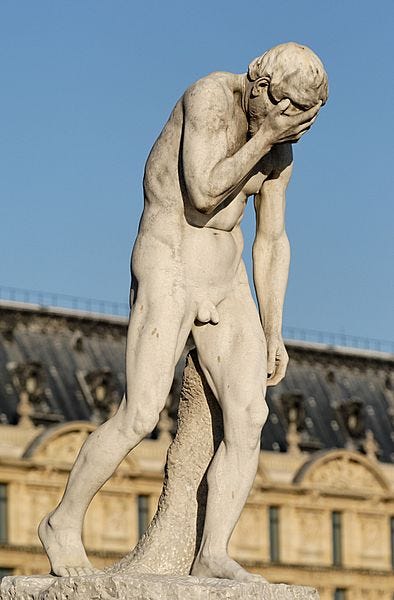
The ambiguity continues: Some hear “blood” rather than “mud” or the first line as “Like my father before me I’m a working man.” Still more: singing of his dead brother Virgil puns on the small mischief people used to describe as “raising cane.” And his brother was “above me”. Is he in Heaven, or simply older, which would make Virgil a teenage soldier himself? But the real issue here is that, by repeating his surname (and his brother’s surname), Virgil evokes another Biblical myth, the original war between brothers that we all know as the story of Cain and Abel (Genesis 4).
Cain was the first human to be born; Abel was the first to die. Cain, refusing to be his “brother’s keeper,” murdered Abel out of envy. Cain had offered “fruits of the soil as an offering to the Lord.” But God favored the shepherd Abel, who offered “fat portions from some of the firstborn of his flock.”
Was it God who had taken the very best? This God who, hearing of the subsequent murder, cast the first curse:
What have you done? Listen! Your brother’s blood cries out to me from the ground. Now you are under a curse and driven from the ground, which opened its mouth to receive your brother’s blood from your hand. When you work the ground, it will no longer yield its crops for you. You will be a restless wanderer on the earth.”
Still, Cain received a mark of protection from God, who allowed him to marry, have children and build the first city. The ambiguities in the song seem to mirror the ambiguities in the myth itself, as carried forward in popular culture. John Byron, in The Legacy of Cain in Pop and Rock Music, notes that “While sacred music rarely mentions Cain and/or Abel, there are dozens of references to the story in pop/rock music”. Many interpreters understand it as a curse and a badge of shame:
The landed aristocracy, exploiting all your enmity,
All your daddies fought in vain,
Leave you with the Mark of Cain. – The Indigo Girls
In the Bible Cain slew Abel and East of Eden he was cast.
You’re born into this life paying for the sins of somebody else’s past. – Bruce Springsteen
There is lonely and there is lonely.
And then there is how I feel right now.
Perhaps only Cain when he’d slain his brother
Could ever come close to knowing how. – Prince
John Steinbeck took the title of his novel East of Eden from Genesis 4:16: “And Cain went out from the presence of the Lord, and dwelt in the Land of Nod, on the east of Eden”. “Nod” is the Hebrew root of the verb “to wander”.
The hero of the 1952 film High Noon, Will Kane, represents radical individualism in the defense of communal values. He defeats his alter-ego Frank Miller, who represents narcissistic vengeance. Curiously, both of them are both ruled by clocks (associated for centuries with Kronos).
But Virgil Caine’s land will no longer support his family; he must chop wood to make ends meet. So we ask again, whom is he addressing when he cries, “You take what you need and leave the rest”?
Ambiguity and our need to resolve it produces the emotional force that drives many of our best songs and some of our myths. There is irony here as well. According to Shi’a Muslim belief, Abel (”Habeel”) is buried in Syria. Until quite recently, the latest war of brothers continued to rage there.
Below the Cain and Abel story lies another one, as I write in Chapter Nine of my book. Our economic myths follow from our historic assumptions about the infinite resources of an “empty” American land. However,
In truth, modernity assumes scarce resources – fuel, food, education, power, freedom, knowledge and especially love. These assumptions begin in our monolithic creation myth, the expulsion from Eden, and lie, along with the compensating belief in progress, at the core of all western thought. The Old Testament provides occasional visions of plenitude (manna from Heaven); but these are followed by laws and restrictions, which, when disobeyed, result in expulsion. It is, writes Regina Schwartz (in The Curse of Cain), a world “where lying, cheating, stealing, adultery and killing are such tempting responses to scarcity that they must be legislated against.”
Biblical stories of fathers and sons are utterly rooted in scarcity assumptions. Isaac cannot bless both of his sons; apparently there isn’t enough to go around. Forced to compete for the blessing, they establish a pattern in which the father rejects the loser. Earlier, Jehovah had preferred Abel’s offering to Cain’s. Even God doesn’t have enough blessing to satisfy everyone. Jealousy, rivalry and murder all follow. This core text of monotheism defines identity as something that is won through competition, at someone else’s expense.
More ambiguity: the line “…but a Yankee laid him in his grave” fits the meter of the song and sounds authentically archaic. But Robertson could have written it differently and still fit it into the rhyme and meter. In the context of fratricide – death at the hands of one’s own brother – doesn’t “laid him in his grave” sound like a gentle act of respect and reverence, a holy ritual? Indeed, the lyrics don’t even indicate that the Yankee had actually killed Virgil’s brother, only that this “proud and brave” teenager was dead. Indeed, as we consider the mythic implications, the “band of brothers” on either side of the firing line have much more in common with each other than they do with the plantation owners and industrialists – the fathers and the father gods – who have sent them to murder each other.
To follow the Biblical tone, all we really know is that a jealous father god, possessing a very limited capacity for blessing, requires – repeatedly – that brothers compete with each other. It’s an old story, but with different mythic implications. In Greek myth, as opposed to Hebrew, sons see the father as a common enemy. In The Family Curse, I note:
Indeed, biblical brothers often fight each other (Cain/Abel, Jacob/Esau, Joseph and his brothers, Amnon/Absolom) instead of their fathers. Unlike the Greeks, the Hebrew patriarchs seemed to deliberately promote sibling rivalry, knowing that if brothers were to love each other, they might unite and overthrow them.
Why do these brothers fight each other? To prove their worth, to win a blessing that can go only to one of them (certainly not to their sisters)? Or because their father is driven to replicate the wounding he received from his father?
What if history and theology didn’t literalize these images? What if we knew the Latin root of compete as “to strive together,” or “to petition the gods together”? We do know that their descendant Abraham would be willing to sacrifice his only son to prove his worth before this same god, and that in 1917, British officer Wilfred Owen would write from a trench in France:
The Parable of the Old Man and the Young
So Abram rose, and clave the wood, and went, And took the fire with him, and a knife. And as they sojourned both of them together, Isaac the first-born spake and said, My Father, Behold the preparations, fire and iron, But where the lamb for this burnt-offering? Then Abram bound the youth with belts and straps, and builded parapets and trenches there, And stretchèd forth the knife to slay his son. When lo! an angel called him out of heaven, Saying, Lay not thy hand upon the lad, Neither do anything to him. Behold, A ram, caught in a thicket by its horns; Offer the Ram of Pride instead of him.
But the old man would not so, but slew his son, And half the seed of Europe, one by one.
Our American myth of (white) brother-against-brother offers us a seemingly happy ending. The nation was torn asunder and then reborn when Reconstruction ended. But it could only do so by colluding in a newer but equally toxic story in which the original wounds of racism would be covered over rather than healed. The wounds would fester for over a hundred years.
Fratricide perfectly describes the impact of the war upon the American soul, which more than that of any other nation is split against itself. The word evokes such emotion precisely because Americans still hope to heal that unresolved split in the psyche.
Thinking of the sacrifice of the innocents, we consider the first verse again: In the winter of ’65. The song does not say eighteen-sixty five.Bear with me, please. Of course it’s about the Civil War. And yet…It was written at the height of the Viet Nam war, when a hundred Yankees were being laid in their graves every week. And yet…for every American death there were hundreds of Vietnamese, Laotian and Cambodians. His original 1969 version was followed two years later by Joan Baez’s version, which, sung by a woman and civil rights activist, added both pathos and even more paradox. Martin, Malcolm and the Kennedys were dead; perhaps, writes Jonah Begone, the song could speak to a larger sense of defeat for the left, a feeling of disappointment of early promise that had gone unfulfilled.
Stoneman’s burning of Virginia’s crops resulted in mass starvation. It was a war crime known in international law as “collective punishment”. It’s what the Nazis did to countless towns such as Lidice in Czechoslovakia or Kalavryta in Greece. It’s what the Hebrews did to the population of Jericho when “the walls came tumbling down”, and it’s what their descendants do every day in Gaza.
In 1965 Vietnamese peasants were “just barely alive”. Massive aerial bombardment and spraying of toxic herbicides over huge swaths of the country was genocide. Americans may be the only nation in history to declare the concept of “free fire zones”, but they may have applied it first in 1865, or perhaps in 1676.
1965 saw resistance in Viet Nam and also in the streets of Watts, California – a century after the fall of Richmond, the Civil War was still raging. A half-century further on, urban police, the descendants of the Southern slave patrols, can still murder unarmed Black men with impunity.
In mythological and ritual terms, to “drive Dixie down” is cata-strophic, to be turned down, away from our obsession with the light, with the gods of the sky, with the myths of growth and national purpose, with the flights of the ego and the spirit, and back towards soul. It is to be humiliated, to return to contact with the humus, the earth. But it is also to be offered the possibility of grieving, reconciliation and healing.
So, the song evokes Hebrew myth (Cain & Abel), Greek myth (Kronos) and American myth (progress, scarcity, fratricide, the Lost Cause). And now we understand why the narrator’s name is Virgil. The Roman poet Virgil composed the Aeneid, the epic that tells how Rome was founded by the last survivors of Troy, another city that, like Richmond, invaders had destroyed. A thousand years later, Dante, in The Divine Comedy, chose this same Virgil to be his guide in the underworld, the place of soul-retrieval.
Part Three
As long as you’re south of the Canadian border, you’re South. – Malcolm X
Ultimately, Virgil’s lament is not only for the South. It is for America’s soul, and this is why The Night remains such an emotionally powerful work of art. In a culture that continues to deny death, that condemns a quarter of its children to poverty, that refuses (like the Southern oligarchs) to accept that its time is over, that enacts the old myths of the sky gods at every opportunity, that is (in W.S. Merwin’s words) “up to its chin in shame, living in the stench it has chosen”, that has so few grief songs, we need to hear it and sing it out loud.
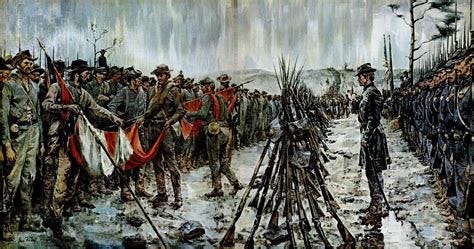
We need to think about Joshua Chamberlain, a Union general and hero of the Gettysburg meatgrinder, wounded six times. He was present at the awesome spectacle of Robert E. Lee’s surrender on April 9th, 1865. He looked closely, perhaps for the first time, at those starving “Jonnie Rebs” who so recently had been shooting at him:
Before us in proud humiliation stood…men whom neither toils and sufferings, nor the fact of death, nor disaster, nor hopelessness could bend from their resolve; standing before us now…thin, worn, and famished, but erect, and with eyes looking level into ours, waking memories that bound us together as no other bond…What visions thronged as we looked into each other’s eyes!...On our part not a sound of trumpet more, nor roll of drum; not a cheer…but an awed stillness rather, and breath-holding, as if it were the passing of the dead!…How could we help falling on our knees, all of us together, and praying God to pity and forgive us all!...For they were fellow-soldiers as well, suffering the fate of arms…We could not look into those brave, bronzed faces…and think of personal hate and mean revenge…Forgive us, therefore, if from stern, steadfast faces eyes dimmed with tears gazed at each other…
A fine place to end, but one man would not reconcile. When Chamberlain remarked to Southern General Henry Wise that perhaps now “brave men may become good friends.” Wise replied,
You’re mistaken, sir. You may forgive us, but we won’t be forgiven. There is a rancor in our hearts which you little dream of. We hate you, sir.
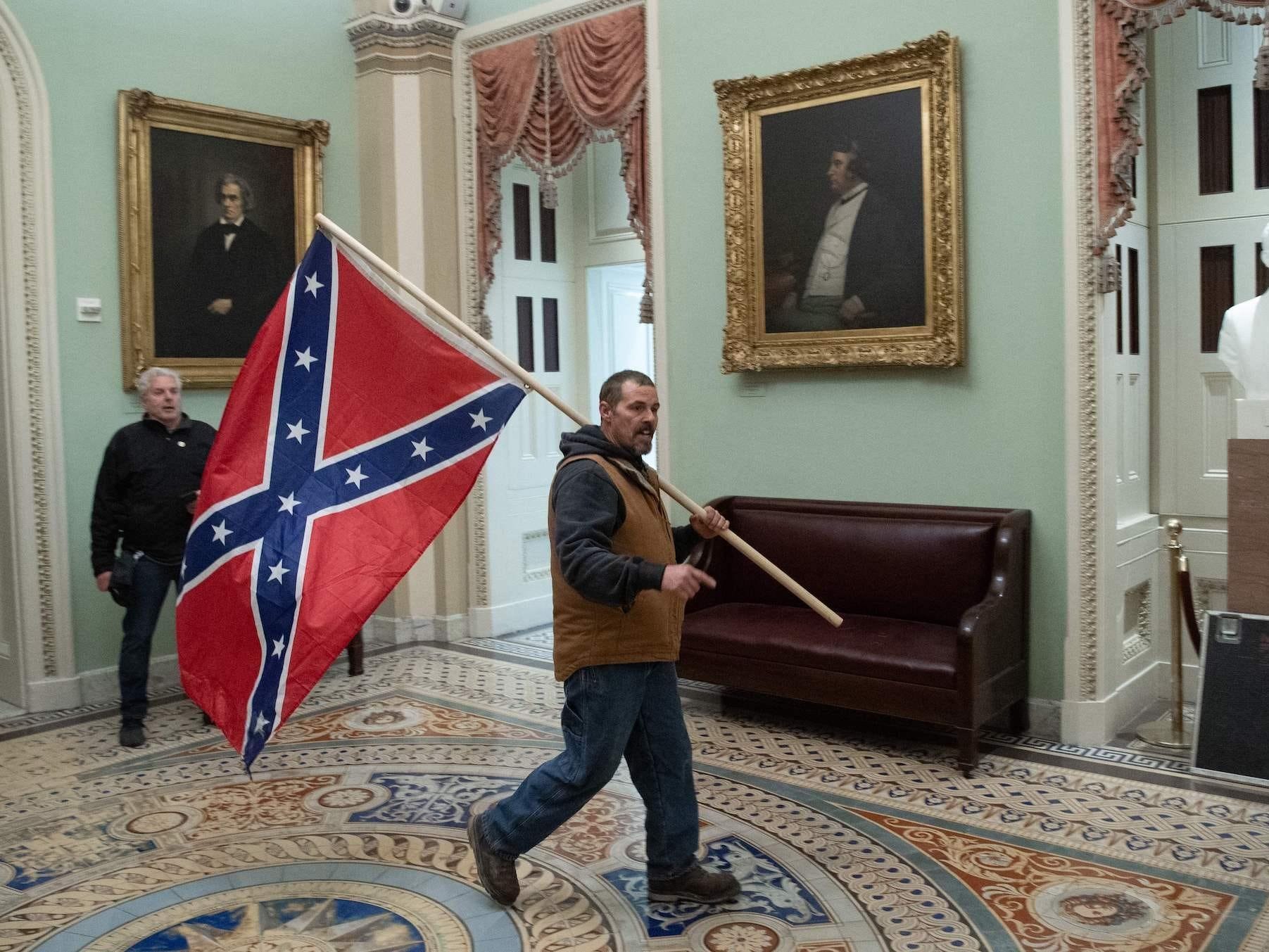
Eight generations later, we admit that the South really didn’t lose the Civil War, that the Lost Cause myth is still alive, and that the South carries the mark of Cain in both its meanings. Many see The Night and songs such as Sweet Home Alabama and I’m A Good Old Rebel as emblems of regional pride:
And I don’t want no pardon For what I was and am I won’t be reconstructed And I do not give a damn
We are back to the question we began with: Why does the The Night continue to move us? We can’t finish this enquiry without acknowledging the darker side of that regional pride. The Band was Rock ‘n Roll royalty; but millions perceived The Night as a country song, for two reasons.
First, Leavon Helm’s distinctive “twangy” vocals (see Geoff Mann’s article Why does country music sound white? Race and the voice of nostalgia) are a racial signifier that marks all country singing and playing as “white” music, produced and consumed almost exclusively by white people.
Secondly, in expressing recognizably white, working-class experiences, it is the voice of nostalgia, as Mann writes:
...in the construction of an idealized past-ness, country music not only ‘talks white’, but it is ‘whites’ who hear it, and whose whiteness is produced and reproduced by what they hear. The songs of a racialized and mythic ‘used to’ sound a present in which whiteness makes sense retroactively, calling white people to their whiteness...The narratives of loss these songs relate take several forms in country music, but in general, they valorize things like a return to ‘simplicity’, moral clarity, social stability and cohesion, small-scale community and a ‘slow pace’, honesty, loyalty, tradition, all of which are usually framed as in decline.
Country music needs that signifier, Mann goes on, to shore up an origin myth in which it was “born of the hardships and everyday struggles of the poor southern ‘hillbilly’ culture that subsisted in the shadow of the plantation mode, and which...survived into the present in a modified, but still more or less pure, stream of ostensibly ‘authentic’ white culture.”
Regardless of The Band’s original intentions, and despite the song’s disinterest in race, The Night invokes historical trauma that many have easily perceived as familiar in country music’s locus of white resentment:
The ‘vanishing present’, and all the presents to come, are by definition the object of country music’s often mournful polemic. Time is happening to those to whom country music calls, and it is the movement from the past through the present and beyond, to the most radically different ‘other’ of all, of which they are thus innocent...American whiteness is premised on the notion that ‘average’ (white) people are victims of an institutional and social disfranchisement that challenges not just the racial order, but a social structure that ‘whites’ created. The opposition to these changes finds its popular justification not in racial reasoning, but in the ‘understandable’ opposition of ‘the silent majority’ to disorder and instability.
We mythologists attempt to understand historical trauma in a broader context that would include all of us, not just white southerners. I pursue this question in Dionysus Looks at Mental Illnessand Why are Americans so freaking crazy?We recall that “nostalgia” (Greek: “return”) refers not to another time, but to another place.
Even after four centuries of white (and black) residence on this land, we tread uncomfortably – and disrespectfully – upon it. We remain exiles, uninvited guests longing to be welcomed, to call it home. It will be lengthy and painful, but the way through is by re-awakening our indigenous souls. Learning who we are, below the easy identifications with nation, ethnicity and brand names, may lead us to love where we are, and perhaps those who live near us.
Myth implies that our troubles have happened before, and that there is still time to change, to awaken from this dream of innocence and return home. A study of history and psychology should also remind us that it took – and takes – massive amounts of money and continuous, propaganda to manipulate the white working class into ignoring their own best economic interests and the possibility of solidarity with other oppressed people in favor of the politics of hatred and the fleeting benefits of privilege. This fact alone should remind us that people are not inherently biased against each other.
You’ve got to be taught to hate and fear, You’ve got to be taught from year to year, It’s got to be drummed in your dear little ear— You’ve got to be carefully taught! – Oscar Hammerstein II, South Pacific
And not all Southerners are charged by the old myths. One challenge for an artist, especially one born to privilege, is to reframe them, or in this case to re-write song lyrics, as Early James did with The Night.
In the first verse, he changes “a time I remember oh so well” to “a time to bid farewell”. His version of the chorus, instead of mourning that downfall, is Tonight, we drive old Dixie down.In his final verse, he rejects both the Lost Cause and the myth of the Killing of the Children:
Unlike my father before me, who I will never understand Unlike the others below me, who took a rebel stand Depraved and powered to enslave I think it’s time we laid hate in its grave I swear by the mud below my feet That monument won’t stand, no matter how much concrete…
Or we could listen to the original lyrics of the old Irish song Johnny I Hardly Knew Ye (much later, When Johnny Comes Marching Home would steal the tune), especially the last stanza:
They’re rolling out the guns again, hurroo, hurroo They’re rolling out the guns again, hurroo, hurroo They’re rolling out the guns again But they never will take our sons again No they never will take our sons again! Johnny I’m swearing to you.
What do we conclude from all this? We need as many grief songs as we can find. We need to constantly interrogate our mythic productions (including popular music) and reframe them for our children. And as for our history of demonizing the “Other”, the Hindu sage Ramana Maharshi said: “There are no others.”